Sunday, August 25, 2013

A Song of Ice and Fire, pt. 2

I admire George R.R. Martin, I aspire to be him...but, Christ, I doubt I’d want to literally be him. Fanboy rage, anyone? It’s rather well known that Martin has to go through life fending off the snarling, snapping jaws of his own devoted readers. The dude is about two-thirds of the way through writing an epic, gigantic fantasy series that many consider better than Tolkien (if I’m one of those people, I’d never admit it, cough cough). He’s been put on a pedestal by a whole lot of nerds, and the thing about nerds is that they’re utter bastards to the things they love. And George R.R. Martin is not the kind of guy who whips off a book a year. Oh, no. He has so many ideas, so much he wants to include, that he grapples with his own narrative. He’s created a monster. Two monsters, actually: his titanic series and his impatient, judgmental fanbase. Which brings us to the problematic fourth and fifth books in A Song of Ice and Fire. This continues my last post on the topic.

A Feast for Crows and A Dance with Dragons are awesome. I loved them. That said, they also suck. Boy, do they suck. For the benefit of non-fans, assuming they haven’t fallen asleep by now, I shall explain why. As Martin wrote the fourth book, it got out of hand: too huge, too sprawling, too many POV characters who needed proper care and attention. The only thing he could do, really, was prune the manuscript, saving a bunch of material for the fifth book. To the utter rage and frustration of many, he did this by dividing the narrative by characters rather than chronology. Picture this: you’ve waited forever, for-fucking-ever, to learn what happens next. A Feast for Crows FINALLY appears on bookshelves, you spend your gas money on the hardcover, and as you begin to read it, you make the horrific realization: someone’s missing. Several someones. There is no trace whatsoever of badass exiled princess Daenerys Targaryen, snarky fugitive dwarf Tyrion Lannister, or crippled mystic-in-training Bran Stark. Jon Snow, everyone’s favorite know-nothing Watch commander, gets a mere cameo. Again, for the benefit of non-fans (who I’m sure have fled screaming at this point), I must explain that these characters are PRETTY FUCKING IMPORTANT AND BELOVED. Instead, we get...Brienne of Tarth searching endlessly for Sansa Stark in all the wrong places? Samwell Tarly puking a lot? What is this shit? Why is half the novel cluttered with Ironborn, whom no one likes? Who the fucking hell is “Areo Hotah” and why does he get his own chapters? Did fan-favorite Davos Seaworth just die offscreen with no fanfare? MARTIN, YOU COCCCCKKKKKK!!!

Yep. All this happened a few years ago so I didn’t experience it firsthand, but I’ve heard a great deal about the hate people have for A Feast for Crows. And I agree, it’s the weakest entry so far. Martin’s decision to leave a bunch of the main protagonists out was a ballsy one and won him little love. He opted to focus on things that, in the long run, weren’t as important. Grandiose new subplots were dragged onstage; we got a whole lot of the scheming Greyjoy family as they scrambled to elect a new ruler, and we met the Martells from the southern province of Dorne, who had their own dreams and schemes going, and it was...hard...to...(yawn)...care that much. Feast has less action than the previous three books and more meandering. Honestly, my favorite chapters belong to Cersei Lannister, the icy-cold queen mum of King’s Landing, who, up until that point, had been an evil bitch who we all loved to hate. But Feast got inside her head for the first time, and damn if she didn’t become someone I was perversely rooting for. One of the best things about Martin’s series is the incredible, amazing, and numerous strong female characters. Arya Stark, Daenerys, Brienne, Asha Greyjoy, Ygritte...these are women whom all women can root for, women who defy convention and walk their own path while still embracing womanhood. Watching Cersei battle her political rivals and struggle to keep her house of cards from falling down...well, it was far more gripping than Brienne’s fruitless scavenger hunt, that’s for sure. Yeah, A Feast for Crows doesn’t quite work, but the great thing is, it’s still a delight to read. That’s how skilled Martin is.


A Dance with Dragons is loads better, though not without its narrative gremlins. The first chunk of the book takes place concurrently with the previous volume, forsaking Westeros (for the most part) to focus on the far North and the lush, bloodsoaked Eastern continent of Essos. Here’s where Martin really broadened his canvas, and also where the series as a whole started feeling top-heavy to me. We get our fix of Dany, Tyrion, and Jon Snow, and their adventures do not in any way disappoint, but the farther they travel from the previously known narrative atlas, the more one wonders if Martin can reign things back in. The story used to be about who would get to rule Westeros and what to do about those undead Others beyond the Wall, and it is still about those things, but it’s also about a zillion other plots and missions and vendettas and mysteries and personal journeys. This is best illustrated during the second half of Dance, when the timeline catches up with that of Feast and Martin jumps around, visiting all his characters and just sort of...checking in. Nudging each subplot further along in a vague kind of way. I know he’s got two more books to go, each clocking in at over a thousand pages, but considering how many plates on sticks he’s now spinning, how’s it all gonna fit? Dance is a wonderful book, I loved every page, and when it ended, I felt a little anxious. Do we really need another claimant to the Iron Throne? Does anyone really care where Rickon’s been all this time? When the hell will Dany stop dragging her feet and sail for Westeros? How long’s it gonna take Arya to become the hardcore ninja assassin she was always meant to be? I know this is confusing to non-fans (who I must have reduced to a fetal position by now), but imagine how it is when you care about all this!

Basically, Martin needs to drop an asteroid on Westeros. I don’t mean that literally (well, it’d be cool, but...). I just mean that he should grab all his scattered, far-reaching plot strands and find a way to knot them tightly together for the big, epic finish we all crave. We already know he’s brutal to his characters (Dance ends with the maybe-death of yet another beloved main protagonist), so I’m guiltily wishing he’d cull away a lot of the peeps we don’t really need and find his way back to a focused narrative with main characters in the single digits. I’m sure we could spend many more books wandering through the glorious vistas of his fantasy world, but if we do that, dude’s gonna croak before he wraps it all up. He’d BETTER have a fucking endgame in mind, and he’d better get there without another bushel of sidequests and distractions. Now do you see why I’d never want to be George R.R. Martin? His series is a fucking frankenstein monster and it’s all his fault. And we, his fans, know it. Hell, I remember reading an entire New Yorker article devoted to the love-hate relationship between Martin and his readers. Now that I’ve read the books too, I get it. The Winds of Winter should be out next year. Should. Should should should. Meanwhile, the forums are getting nastier and Martin’s growing older and, oh yeah, that silly little TV show is catching up...............

Why does all this make me so gleeful?

To be continued! Someday!

Tuesday, August 13, 2013

To Squee Or Not to Squee: Pacific Rim

Checking another one off the Cautious Enthusiasm list!

Some directors get away with a great deal because we love them. Their movies rarely fail to entertain, so we allow them to indulge their specific stylistic flourishes even when they become punchlines. Hey, they’ve earned the right to stick an “-esque” at the end of their names, yeah? That’s why I don’t mind Jean-Pierre Jeunet’s windup-toy whimsy, Tarantino’s smug fanboy plagiarism, or whatever the hell psychotropic drug Tarsem Singh is feeding his production designers. And Guillermo del Toro? He could make a PSA about slippery linoleum and I’d still pay to watch it. So when he decides to make a summer blockbuster in which giant monsters called Kaiju (Japanese for “Pikachu”) get into deafening punching matches with equally giant robots called Jaegers (German for “beer”), I’m nervous. What about del Toro’s baroque sensibilities? Where will there be room for gold filigree and organs in vats and goblins with bicycle wheels fused to their armpits and the other stuff he usually incorporates? They’re what make him an awesome director, not his box office numbers!

I’ve seen Pacific Rim and it’s all good. He needed to get this one out of his system and I can dig it. This film is DUMB, but not Transformers dumb. Transformers dumb comes with a side order of vicious cynicism: “We know perfectly well that you’re gonna spend money on this turd and buy Mountain Dew just because Bumblebee’s on the can, so let’s not pretend anyone cares about the actual movie here. Present your anuses for sodomizing now.” Pacific Rim is a seven-year-old boy who drank five things of Crush for lunch and is flailing around on his bedroom floor with all his toys, going “POW!!!! SPLAT!!!! NEEEEEYYYYOOOWWW YOU’RE DEAD!!! I SAVED THE WHOLE WORLD!” Having an enviable degree of fun. The boy grew up to be Guillermo del Toro in this case, and someone gave him enough money to make a movie where characters are named things like “Stacker Pentecost” and talk about dimensional rifts and telepathic linkage with a straight face. Where everything is huge and loud, but in a kinda joyous way, even when the future looks bleak. Believe me, del Toro knows what movie he’s making. Me and my friends couldn’t stop giggling. He knows when to milk a shot or angle for shamelessly cheesy badassery, when to turn up the Dubstep. He knows his characters are total cutouts and that we’ll guess who’s gonna live and who’s gonna die three minutes in. So?

Nothing in Pacific Rim makes much sense. Monsters from a dimensional rift start fucking up our cities, we build huge robots to strike back, they evolve in turn, and it becomes a Freudian contest of who can out-phallic-symbol the other. The film’s also suffering from what I like to call Snow White Syndrome. If you think about it, the original Snow White story features the world’s dumbest princess versus the world’s most incompetent evil enchantress, and the winner is whoever fails the least. Same thing here. Out of all the weapons to fight the Kaiju with, why would we design humanoid robots? Bipedal things fall over easily, hello! And why rely on two pilots who are telepathically linked, so one nasty flashback or killer hangover can ruin everything? On the other hand, why are the bad guy monsters taking forever to assault us, sending one foe at a time, giving us endless opportunity to retaliate? Are they taking tips from the dumbfuck aliens in Independence Day? And why do both the Kaiju and the Jaegers have an arsenal of powers, weapons, and attacks, but only remember to use each one exactly once? When a beastie gives off an EMP that shuts down not only the Jaegers but also the good guys’ HQ, our heroes would be in huge trouble if ANY of the subsequent Kaiju EVER did that again. The stupidity knows no bounds. But...so?


So...this movie is a juicy mound of silly fun. Del Toro had fun making it. Why can’t we have fun watching it? He keeps his playful touches even in the midst of generic action. The movie is bursting with neon colors (the Kaiju look like they’re off to the rave) and a fetishistic level of detail. The actors are fetishized too: Charlie Hunnam (as the haunted hero) squares his all-American jaw from within his sexy robo-armor, Idris Elba (as the hardass yet empathic commander) soaks the screen in daddy-figure charisma, and when Ron Perlman shows up...well, I won’t spoil that one because everyone should have the chance to lose their shit. I do pity poor Rinko Kikuchi, the token woman, stuck with a goo-goo-eyed, virginal Little Sister role who can’t operate without the penis-sporting guardians in her life. Oh, and Charlie Day pretends to be Rick Moranis and fails. But all these folks are the little Playmobil people dwarfed by the towering Robot/Monster Action Figures with Extendable Parts and Real Working Missiles on young Guillermo’s bedroom floor. Deal with it.

My biggest grievance is that one movie can’t contain all del Toro’s ideas. His Hellboy series suffers from the same problem, but it’s really bad in Pacific Rim because of all the time hogged by epic beat-downs and crumbling skyscrapers. It’s like Oblivion in that there’s too much narration at the beginning, but worse because of all the interesting stuff we glimpse in the opening montage that’s never dwelt upon again. Having just re-read the amazing World War Z (screw the movie; the novel is a horror masterpiece), I wanted Pacific Rim to go the same route and paint a global picture. How does humanity react to the Kaiju threat? How does each nation respond? We get glimpses, and the Jaegers are clearly defined by the culture that built each one, but there’s no time to stop for details. What about the whole telepathic-link thing? How was it invented? How does it work? That could be a film all by itself. So could one subplot involving a shady underworld devoted to scavenging dead Kaiju parts (those scenes are when the movie is most del Toro-esque). And the bad guys -- what’s their world like? How do they make/breed the Kaiju? Del Toro must have all this on record somewhere; you can detect the joyful effort he put into world-building. But he needs a different medium to share it with us. He needs a long comic series, or a thick trilogy of novels. One film is not enough; it has to live in the present. And I doubt there will be more films because Pacific Rim kinda flopped. Bless his heart, del Toro isn’t gonna compromise his weirdness enough to appeal to the drooling masses. But he’ll always have us faithful. We get it. Even when it’s stupid and indulgent, we get it. What director could ask for more?

VERDICT: If you go bonkers for del Toro, Pacific Rim is a movie to squee at!

Tuesday, June 25, 2013

Top 10 Plot Twists

WARNING: NOT ONLY DOES THIS POST CONTAIN SPOILERS, THIS POST CONSISTS ENTIRELY OF SPOILERS. THE ENTIRE POINT OF THIS POST IS TO DISCUSS SPOILERS. SO IT’S YOUR OWN DAMN FAULT IF SOMETHING IS SPOILED FOR YOU.

Bruce Willis is a ghost. Rosebud is a sled. Robert de Niro is the Devil. Darth Vader is Luke’s father. Soylent Green is people. There’s a reason all these are legendary. In a fictional story, few things stir the audience like a sudden, out-of-nowhere plot twist. Sometimes it can dazzle you. Sometimes it pisses you right the fuck off. But you can’t deny that the movie, show, book, or game wouldn’t have quite the same impact if the plot hadn’t taken that neck-snapping turn. It can move mountains. As I write this first paragraph, I’m eagerly waiting to hear fan reaction to “The Rains of Castamere,” a new episode of Game of Thrones in which [SPOILER] and [SPOILER] will be [SPOILER] by [SPOILER] in the event known as [SPOILER McSPOILER]. In this case, I know what’s about to happen, but many fans will get to experience the awe and heartbreak for the first time. I know by the time I finish and post this, people still won’t be over it.

Seems only fitting that I should lay down a list of story turns that, for whatever reason, blew me away.

DANG-BLASTED’S TOP 10 PLOT TWISTS


Chrono Trigger: Chrono Dies
So I hear Aeris croaks in Final Fantasy VII. I hear it because it’s brought up all the damn time, as though it were the plot twist of the decade or something. Not to stomp on what is certainly a tragic and poignant twist, but for me, the bigger impact came in Chrono Trigger, the spiritual cousin to the Final Fantasy series, in which the hero, Chrono (I refuse to spell his name without an H), sacrificed his own life while fighting the evil Lavos. This would’ve been shocking enough if it had come at the climax, but it happened like two-thirds of the way through the game. Up until that point, the entire game had been from Chrono’s POV, and suddenly, his merry band of sidekicks were bereft and leaderless. Seriously, how many games kill off their sole main protagonist partway? Okay, yeah, obviously he comes back to life later. Except when he doesn’t, because the game has multiple endings and you, the player, can totally choose to rush to the final boss and leave Chrono permanently deceased. I love this game for the unexpected directions it takes with its plot, and I’d say Chrono’s sacrifice tops the Holy Shit meter.


Fables: Wait, The Evil Mastermind Is WHO?
The Fables comic series has thrown some pretty crazy twists at its readers, but for sheer bizarre brilliance, you can’t beat the initial reveal of the Big Bad. The backstory is that the characters of myth and fairy tale had to flee their homelands, which were taken over by a mysterious evil overlord known as the Adversary. Who is he and where did he come from? After fighting an army of wooden puppets, the good guys guess that Pinocchio’s father, Geppetto, must be enslaved by their enemy. This theory holds until Little Boy Blue undertakes a quest into the Homelands to assassinate the Adversary, which he does with rather suspicious ease. He soon learns the truth: the Adversary, a big scary dude with horns and red eyes and shit, is merely another puppet. The true Adversary, the power-hungry psychopath who killed and conquered his way to near-absolute power, is one sweet old woodsmith. Yep, Geppetto is the bad guy. And he has been the whole time, hiding behind various wooden minions. Not only that, he has the Blue Fairy locked in his closet and constantly milks her for her life-giving magic. There was plenty more to come after this revelation, but it’s hard to believe that ANYONE saw it approaching. I sure didn’t.


The Family Tree: Time-Traveling Humans From the Future Aren’t Human
Books have one fantastic advantage over other media: because you only know what you read, the author can trick you, and if it’s pulled off well, it can result in a twist of stunning impact. The Family Tree is an unassuming sci-fi novel by Sherri S. Tepper that’s so poker-faced, its twist hits like a literary orgasm. It follows two storylines in two time periods: the present day, and a postapocalyptic future. In the latter, an eccentric band of adventurers set out to find a monastery where they might travel back in time. For the entire first half of the book, nothing seems amiss. Then the future folk leap back, the two storylines converge, and we learn that the “people” who inhabit Earth down the road.......are animals. Sentient animals. Thanks to genetics gone haywire, they will run the world, whereas humans will revert to dumb beasts of burden. Somehow, Tepper writes the future scenes without letting on that she’s writing about monkeys, cats, otters, and the like. It’s so sublime that the rest of the book is almost lame by comparison. But it’s worth it. And it could never work on a screen.


Harry Potter and the Prisoner of Azkaban: Ron’s Rat’s a Dude, Hermione’s Been Time-Hopping, and Harry Saves His Past Self
The Harry Potter series, for all its flaws, has some pretty slick plot twists, often falling into the template of “So it was YOU the whole time!” Prisoner of Azkaban, which many would say is the strongest entry (in the film series, for sure) is wonderfully merciless in the way the third act piles on twist after twist. Crazy enough to learn that evil, psychotic Sirius Black is a wronged hero, but how about learning that Ron’s beloved pet rat, Scabbers, is actually a villainous human in disguise? These things alone would serve most narratives, but J.K. Rowling’s only revving up. When shit goes bad, good old Hermione reveals that she’s been fucking TIME-TRAVELING all year to get to her classes, and then she and Harry go back in time, witness everything that already happened, and (in Harry’s case) save the asses of their past selves. This is not without plot holes (if wizards can time-travel, why don’t they ever?), but it’s such mind-bending fun. The time-travel is well-forehadowed, but since Ron’s rat has been a “character” this whole time, who could have guessed he was Peter Pettigrew? I love when twists go exponential; sometimes it’s not so bad to be jerked about.


Gone: Welcome to the Human Zoo
While we’re on the topic of juvenile fiction, Michael Grant’s Gone series is an action-packed killfest that’s darker and more gruesome than many Stephen King novels. The premise is that a chunk of California coastline is suddenly surrounded by an opaque, unbreakable barrier, known as the FAYZ. Everyone over fifteen is booted outside, leaving only teens and kids, some of whom develop X-Men-style powers. Civilization on the inside crumbles, buckets of blood are shed, and then, in the fifth book, the desperate US army tries to nuke the FAYZ. I’m leaving out a lot of details, but the important thing is the startling result, which completely shakes up the rules of the story. The FAYZ isn’t destroyed -- instead, it turns as clear as glass. Suddenly, after months of isolation, the youngsters inside the dome are visible to the outside world. They can see and communicate with their loved ones, but can’t get to them. And considering that they’ve been living in a monstrous mash-up of Lord of the Flies, Heroes, and Hell, the rest of the human race isn’t exactly delighted to get a look inside this freak biodome. Although the final book kinda fumbled its chance to really explore the implications, it was still a fantastic twist and one helluva direction for the endgame to take. When you gaze into the abyss...


Life of Pi: Truth is Shittier Than Fiction?
Not done with literature yet, though this one works if you’ve only seen the movie. To recap, resourceful young Pi Patel finds himself on a lifeboat with a zebra, a hyena, an orangutan, and a Bengal tiger. Only Pi and the tiger make it, surviving for months through luck and improvisation. At one point, the plot enters true dream logic when they discover a floating carnivorous island populated by thousands of meerkats. Weird as shit, right? That’s what Pi’s rescuers say. They don’t believe him and demand the “truth.” So Pi tells another story, one that makes sense. One where the animals are people. And when you hear him tell it, you realize that this is probably the objective truth. There was no tiger, no fantastical island. Pi spent months in utter isolation, long enough to lose his mind and gain it back. The question the book dares to ask is, can there be more to the truth than what literally happened? If reality hurts too much, can we be faulted for rewriting it? Pi asks his rescuers which story they like better, and they admit to preferring the one with the tiger. And since no one else witnessed it, since no one can prove it didn’t happen, well...facts ain’t everything. This is one of those twists that makes us rethink the story -- all stories, in a way -- and it’s sublime.


Lost: “We Have to Go Back!”
Hey, I tried. But I simply must stick Lost on this list. It’s a show that loved to throw curveballs at the audience, and each season finale has its HOLY SHIT moments, but none were quite as startling as the cap-off to Season Three, basically the show’s halfway point. See, up until then, Lost had followed the same format: present-day hijinks on a mysterious island, mixed with flashbacks into the lives of the cast. Why wouldn’t we expect anything different? So the Season Three finale gives us a flashback of heroic spinal surgeon Jack Shephard as he spirals into depression, attempts suicide, and pleads with an unknown somebody on the phone. Man, when in Jack’s life did this bad shit go down? Heh. I can clearly recall the stunned silence that filled the room as my friends and I watched Jack meet up with the voice on the phone -- who turned out to be fellow castaway Kate. It took a few seconds for us to realize: this isn’t the past. This is the future. Jack and Kate were rescued from the island, and now Jack, in a complete reversal of his character, is desperate to return. The season ended with him screaming, “We have to go back!” and NOTHING was gonna be the same after that. You had to be there.


Rant: Buster Casey is His Own Father
Can I spoil Fight Club? Everyone knows that one: the nameless narrator and nutjob Tyler Durden are actually the same person. This was pulled off awesomely in both the book and the movie, but let me offer you a twist from author Chuck Palahniuk’s later novel, Rant, that mopped the floor with my expectations. Rant is hard to describe, but it’s basically a dystopian oral history revolving around a messiah/revolutionary/gang leader named Buster Casey. From his humble beginnings to his mysterious disappearance, after apparently discovering time-travel. Yep, time-travel makes its third appearance on this list, but Palahniuk’s take is....wow. Just wow. Bottom line? Buster Casey went back in time to before his own birth, met and raped his mother, then stuck around to help raise...himself. In the weirdest fucking paradox ever, he is his own goddamn dad, and by time-traveling multiple times, he is able to set the course of his younger self’s life from many different angles. In fact, it turns out another supporting character in the book is also Buster Casey in disguise. WTF, Palahniuk. Why does crazy shit like this make me love you even more?


The Shawshank Redemption: Longest, Most Patient Prison Break Ever
This one’s awesome because The Shawshank Redemption is not a prison break movie. It’s about the life and trials of Andy Dufresne as he spends years, decades, behind bars for a double murder he (probably) didn’t commit. So much happens to him, and the whole time, he’s in the process of escaping, ever so patiently. I love how the narrative shows us his escape after the fact, allowing us to be as confused as the other characters, then flashes back to explain how he did it. And it’s all so damn simple. Hiding his slowly-growing escape tunnel behind a series of cheesecake posters. Keeping a rock hammer in his Bible. Getting cozy enough with the corrupt warden that he can steal his spare clothes (“You never look at a man’s shoes,” Morgan Freeman intones with a wink). And busting out during a thunderstorm so no one hears him break into a sewage pipe and slither through a river of feces to freedom. By God, did he EARN it. And it’s so wonderful to see how humble Andy fooled everyone, including us viewers. The fact that he exposes the warden’s crimes? Icing on the cake. Well played, Andy -- you got busy living.


Silent Hill: Shattered Memories: Well, It’s Kinda Right There In the Title...
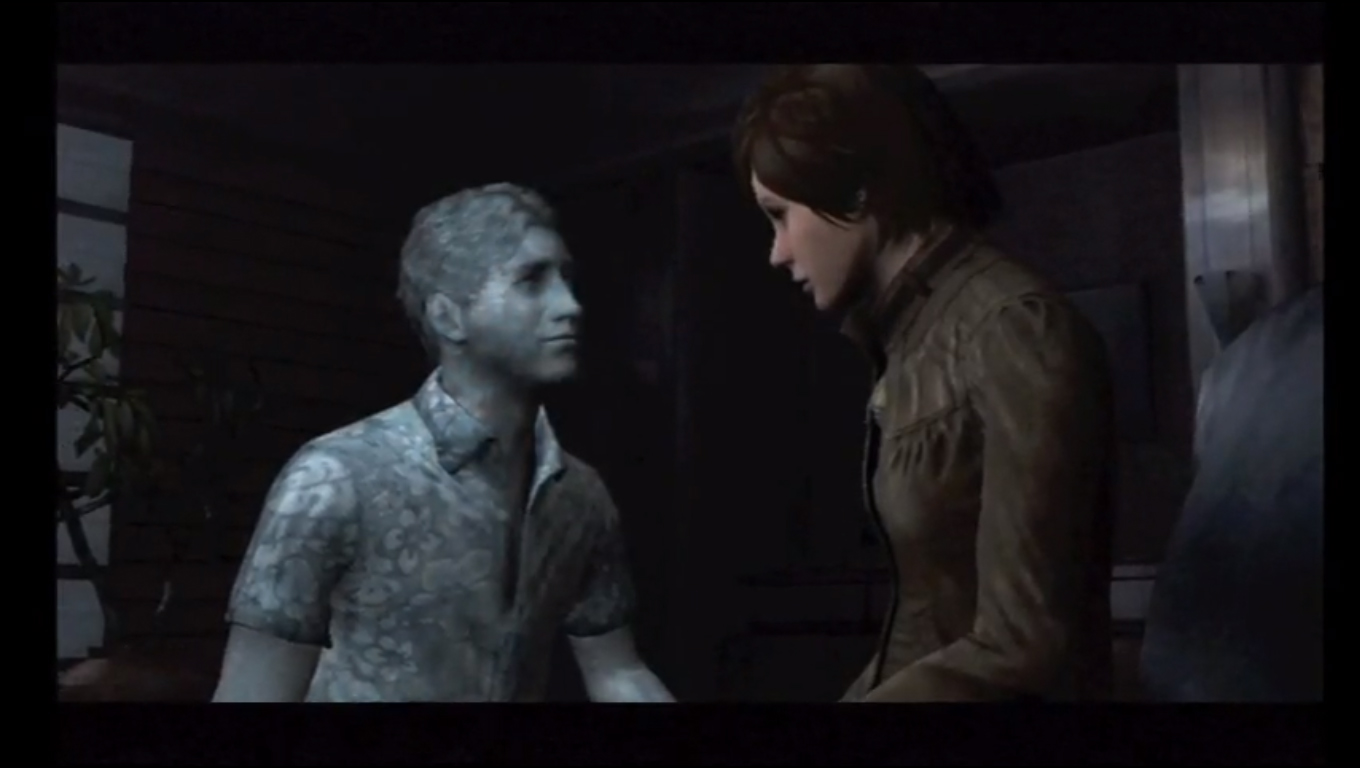
Twists in the Silent Hill series are hit or miss. To me, none come close to the ending of the experimental pseudo-remake that is Shattered Memories. The game is, or seems to be, about poor Harry Mason as he trudges through a blizzard, searching for his little girl, Sharon, in the wake of a car crash. Monsters chase him, reality shifts, and we suspect that a lot of what he sees is only in his head. The gameplay is intercut with sessions in a psychiatrist’s office where the patient is not identified. But the implications don’t sink in until the final scene, when Harry stumbles into the office and we realize that the patient is not him, but Sharon, grown into a troubled young woman -- troubled, in part, because her father died when she was six. Our hero, Harry Mason, is not a living man. He’s not even a ghost. He’s a series of incomplete fragments, an attempt by Sharon to piece together some portrait of the father she barely got the chance to know. The whole game took place inside her head. This revelation is followed by several possible endings, but the point is how wonderfully the twist ties together, not only the game’s mysteries, but also the open-ended gameplay and subtext. Honestly, Shattered Memories isn’t even a survival horror game; it’s a bold concept brought to evocative life.

You see how the best twists can make you love and respect the story even more? I have to grin when the wool is pulled from my eyes and new layers unfold for my consideration. This blog post, for instance. The twist ending is that...

Nah, I’m not gonna spoil it.

Saturday, June 15, 2013

"The Desolation of Smaug" Trailer

As always, my blog posts are infrequent over the summer due to my seasonal job (traveling youth circus!), which requires me to be AFK for long periods. Here’s something short and sweet for ya. I’m geeking out over the teaser trailer for The Hobbit: The Desolation of Smaug, which hit the web at the start of the week. The second film in the trilogy follows Bilbo Baggins and his Dwarf buddies as they journey through the dangerous forest of Mirkwood and reach the Lonely Mountain, where Smaug the Dragon lurks. The trailer shows a lot and teases a lot more, so let’s examine the good and the bad.

THE GOOD BITS

--I know it’s dangerous to make any sort of assumption based on a freakin’ teaser trailer, but does this film look darker in tone than the first one? Maybe? Yeah, it probably chooses to focus more on the action than the humor, but still. We have ominous narration from Elven King Thranduil (Lee Pace), we have all kinds of peril, nobody ever smiles, and there’s even the old cliché about how “you’ll destroy us all!” The narrative has largely left behind its “kooky” aspects like epicurean trolls and Dame Edna the Goblin King, so we might be getting something a teeny bit more in the vein of the original Lord of the Rings trilogy. I’ll take that. Which reminds me...

--Legolas is back...and he’s a total asshole! Awesome! Yes, they wrote Legolas into The Hobbit in yet another obvious callback, but since Legolas is the son of Thranduil, who does make life difficult for the Dwarves in the book, this is hardly canon-raping. Needless to say, Orlando Bloom does not appear to have aged, which is good because this is a younger, more headstrong Legolas who reeeeaaaaaaallllly does not like Dwarves. Ah, the undercurrents of racism that run throughout Tolkien’s work. Eh, I think Asshole Legolas is kind of funny.

--Speaking of Elves...holy shit, there’s one with a womb! The poor filmmakers were apparently so desperate to inject some femininity into this epic sausage-fest that they flat-out invented a new character from scratch: Tauriel (Evangeline Lilly), a fire-haired Wood Elf who’s pals with Legolas and gets to kick major ass, just like Arwen did in the five seconds before she took too much Benadryl and became a weepy-faced zombie! Tauriel’s definitely got more gumption, though. If you ever read my Lost recaps (eww, why would you do that?), you may have noticed that I picked on Evangeline Lilly a lot, but that was more to do with her character. She’s gorgeous and she does the fake accent well, so I’m glad she’s here. Even if the nerds aren’t.


--Other characters and critters get teased! We see Bard of Lake-Town (Luke Evans, who looks and sounds creepily like another Orlando Bloom), we almost get a look at a giant spider, and there’s the random appearance of an angry bear. Spoiler alert: the bear is really a dude named Beorn who is, shall we say, lycanthropic. Plus: fleeting shots of cool new locales, such as Lake-Town and the Wood Elves’ kingdom. Plus: familiar faces like Radagast and Thranduil. Oh, who am I kidding? We all know which tease is the most excited-urine-inducing...

--Smaug, ladies and gentlemen. The trailer ACTUALLY SHOWS HIM. Well, his head. But that’s more than enough to tide this fanboy over. I just assumed they were gonna leave the dragon mostly or entirely unseen. Keep up the obnoxious teasing that’s been going on since the first film. But nope -- they unveiled Smaug, and it wasn’t a glimpse but a long, leisurely look at his scaly visage leering at poor Bilbo. FUCK YES. Just that one shot made me ten times more excited for this movie. But it didn’t quite distract from a few sour points...

THE NOT-SO-GOOD-BITS

--There seems to be way more action in this installment. “Good!” a lot of people will say. “I got so sick of backstory and Dwarf songs during the first one! Bring on the fight scenes!” They may be right, but I worry that The Desolation of Smaug will have the weakest plot of the three. No setup and no real climax, you know? It’s tough to be the second film in a trilogy.

--Crappy special effects, anyone? While the fake scenery was as sumptuous as ever, the action shots featured some incredibly unconvincing CGI people. The Elves in particular looked like boingy cartoon characters. I really hope they’re still tinkering with post-production effects, because I refuse to believe that, ten years later, the effects will look worse than in LotR.


--Wherefore art thou, Gandalf? He appeared very briefly, and a Tolkien film without Gandalf is like nachos without salsa. Problem is, Gandalf disappears from the narrative for a really long time, leaving Bilbo and the Dwarves to fend for themselves. Clearly, the movie will show what he’s doing -- he’s at the fortress of Dol Guldur, investigating this creepy Necromancer fellow -- but they may have no choice but to scale his role back. And while we’re on the subject, why did Bilbo and Thorin, our heroes, appear mostly in quick shots and not get any lines? They’re playing up Legolas and his Elf brethren a lot, but come on. We care more about the MAIN CHARACTERS.

--Some of the dialogue was a bit derpy. I especially liked Legolas and Tauriel: “This is not our fight!” “This is our fight!” “Is not!” “Is too!” “Nuh-uh!” “Uh-huh!” I feel like they could have chosen better soundbites -- again, why didn’t the more entertaining characters get to talk? Well, at least we still have the wonderful Ken Stott (as Balin), who can make absolutely any line sound wise, earnest, and convincing. No wonder they let him narrate all the backstory.

--Oh, good, Nasty Albino Orc Dude is still around. In case we forgot how pointless that character is. Especially compared to...well, every single character who wasn’t created on a computer, and some who were.

--One final thing to be sad about: although we got a good look at Smaug, we didn’t hear his voice. And that is a huge bummer. Because we all know who’s giving voice to the dragon: the one and only Benedict Cumberbatch. Who is pretty much the coolest person who ever lived. Oh, my goodness, that voice of his. That charisma, even in the form of a giant fake dragon. Damn them for not including his voice! Damn them for being smart enough to know what they can gain by withholding stuff from us! I truly believe that Cumberbatch alone is going to make the second film better than the first one.


A few more months and I can see how the actual film measures up! I’m excited. It’ll be the perfect antidote to the bleak, grim, bloodsoaked sobfest that is the second Hunger Games movie. I mean, I’m super-pumped for that one too, but JESUS. I think I prefer Dwarves in barrels to elderly black men getting shot in the head. But I digress.

Tuesday, June 11, 2013

Myst Series, pt. 6

Kairo -- The Legos of the Apocalypse

Before closing the curtain on my Myst review series (for now), I’d like to post about one final game. I played this one quite recently after it caught my eye on Steam. My thought after watching its trailer was, “This looks like Myst!” which meant I was basically sold. The game is called Kairo and was made by developer Richard Perrin, and...kind of defies description. That is to say, I can easily describe what the game is like, but its meaning is far more elusive. If it even has one. It is both elegant and maddening in its sheer, poker-faced ambiguity; you could analyze it in depth, but you might be thinking about it too hard. Does the experience make it worth the artsy-fartsyness? Hmmmmm.

This post may be short, because I don’t have to spend paragraphs unpacking the plot, because there freaking isn’t one. You begin the game standing on some kind of smooth-edged gray architecture in the middle of a blank white expanse. You can walk around, run, and jump. That’s it. There’s only one other structure visible, so you head that way. A passageway leads you into a deep blue space that kinda resembles a throne room. Soon after that comes a grass-green park (?) brimming with what could be abstract sculpture. And so forth. Kairo is composed of smooth surfaces, solid color schemes, ambient gloom, and environments which suggest much but never quite reveal what they are or who made them. There is no real connection between each space, no adherence to the laws of physics -- beyond the fact that several “hub” areas contain portals to other places where you must solve puzzles to ultimately unlock the way forward. As in the Myst and Submachine games, you are a faceless Anybody, entirely alone, surrounded by silence and isolation. And, once again, you’re wandering in the ruins of a once-great civilization. Or are you?


I honestly don’t know. Kairo is, by far, the most obtuse of these games. No plot. No explanation. You do find various cryptic clues: classical artwork, glyphs, staticky screens from which unsettling silhouettes regard you, giving nothing away. The buildings and promenades are grand in scope, though there is a bizarre simplicity to them, as if you’re trapped in a world of titanic Legos. So, is this an advanced civilization that fell to ruin ages ago? Or are you in some type of artificial environment, a guinea pig to higher beings who watch to see what you’ll do? Maybe this is what the end of the world looks like: no hellfire or chaos, just a sad, dusty abandonment of everything we ever created. Monuments to nothing. You see how profound I’m getting here? The thing is, maybe I’m overdoing it. Maybe Kairo is nothing more or less than an interesting puzzle game. It’s kind of nice to have the freedom to interpret, but what if the developers are laughing at me for assuming there’s anything more to Kairo than its surface?


Is this a fun game? Well, yeah, though it kinda lacks lingering appeal. Its visual style is very neat, to be sure, creating deep atmosphere out of basic geometry and oversaturated colors. Its puzzles are okay, but kind of easy; since you can only interact by pushing, stepping on, or bumping against things, it limits what is possible. Push the cube into the alcove? Check! Headbutt the wall switches in the right order? Sure thing! Align the symbols? Man, suddenly I miss Legend of Zelda. I don’t think the CliffsNotes puzzles are the point here. The point is the mystery, and the ability to explore. Both are considerable. Many of the areas are bigger than they need to be, and if you poke around enough, you’ll find hidden easter eggs, bonus puzzles, and a series of concealed glyphs. Yes, there is more to Kairo than initially meets the eye and it does have minor replay value if you’re the obsessive type. But it’s also fairly short and unchallenging. One of those games that’s slightly less interested in being a game with goals and stuff than it is in making a cryptic “statement” of some kind. Games like this can really piss me off, but I forgive Kairo because it doesn’t trumpet its “statement” from the rooftops. By contrast, Braid is a fantastic game, but its utterly smug, text-heavy epilogue (it was a Manhattan Project allegory all along!) makes me want to stomp on Jonathan Blow’s pretentious little feet. Kairo hides its true meaning, if it even has one, and so is marginally less twatty.

Fans of Myst will probably like it, and that’s the important thing. Its makers have tapped into some of the same mystery and melancholy that we remember from the original Myst and Riven. In a way, they’ve stripped all the distracting stuff and focused entirely on the essence. It makes for a cerebral and emotionally stunted game, but it also keeps your attention all the way through. Kairo ain’t quite as good as the Myst games or Submachine -- its opacity ultimately holds it back from greatness -- but it succeeds well enough that I’ll suggest you play through it on a gray, rainy afternoon while sipping tea. Yeah, it’s a rainy-day, tea-sipping game for sure. Hopefully some people will appreciate what I mean.

More reviews in this series may come down the line. For now, though, let us bid these strange worlds farewell, and promise to revisit them again the next time we’re in the mood to get lost in a good game. Quite literally lost. That’s the fun of it.


Myst Review Series

Thursday, June 6, 2013

Myst Series, pt. 5

Submachine -- Fallen Through the Cracks 

In my Myst IV post, I pointed out a couple in-development games that seem to be following in the footsteps of the Myst series -- by which I mean, completely copying it. Let me stress that this is not a bad thing; I’ve always believed that if a formula works, why toss it aside? Myst V tossed the formula aside and I will always resent it for that. However, you can definitely make a game in the Myst spirit without requiring all those lush pre-rendered 3D landscapes. In the spirit of the franchise, let me introduce you to one of the absolute coolest little Flash game series, which you can play for free on the good old Internet. Follow this link to enter....(dramatic pause)....the Submachine.

What is the Submachine? That’s actually a very good question. The creator of the series, Mateusz Skutnik, is a Polish graphic artist, programmer, and all-around awesome-seeming dude. He has a large library of Flash games to explore, including such series as Daymare Town, Covert Front, and 10 Gnomes. But the Submachine series is by far his most popular creation, and it’s easy to see why. These games are small, quiet, and minimalist, and yet they cast an unbreakable spell over the player. It’s hard to describe how evocative they are. Nope, I can’t tell you exactly what the Submachine is, because Skutnik himself may not know. I’m not sure he intended the series to become as epic as it did; the first game plunks you down in a basement where the only goal is to explore, solve some puzzles, and escape. Nothing out of the ordinary -- but even then, something about the lonesome setting and soft, ominous music makes you think there’s way more than meets the eye. When the second Submachine game came out, this one set in a lighthouse, it became clear: you, the nameless protagonist, were trapped in some kind of abandoned world, and there was way more to discover.


The original Myst began with the unknown, but gradually explained itself as you played the game. The Submachine series is eight games long, with more to come, and it still hasn’t entirely explained itself. Maybe it never will. There are a lot of fan theories; my own theory is that the Submachine is some kind of pocket universe, a place that may be accessible from our own in certain soft spots. As you explore, you find what appears to be the jumbled, fragmented remnants of lost civilizations; it’s as if everything that gets forgotten in our world slips through some cosmic crack into the Submachine, which may itself be limitless. Its indefinite size allows for pretty much anything. Submachine 3: The Loop took a drastic departure from the norm and stranded you in a literally endless grid of rooms where puzzle-solving was your only hope of escape. After that, I think Skutnik pulled his ideas together. I’d say Submachine 4: The Lab is the strongest entry in the series, as you discover an abandoned laboratory and find yourself talking to a mysterious someone over a computer. It turns out that you’re the latest in a long string of explorers who have tried to map out the Submachine -- difficult, since it defies all physics. The head explorer dude is a man named Murtaugh who may or may not be trustworthy. In The Lab, you discover a means of rapid transport around different areas of the Submachine, which feels especially Myst-like. But the great thing about this series is that each entry is very different, with its own visual style and puzzle mechanics. The creativity is boundless.

The Lab is followed by two entries that aren’t as compelling. Submachine 5: The Root sheds a little more history on those who explore the Submachine, and is solid from a storytelling perspective, but lacks the wow factor of its predecessor. Submachine 6: The Edge is, in my opinion, the weakest link, stranding you in a smooth-edged, visually dull sci-fi environment where way too many puzzles involve prodding at green icons on computer screens. Like I said, it’s awesome that Skutnik takes each entry in a different direction, but some of his creative decisions don’t quite pay off. Luckily, he’s back on track. Submachine 7: The Core is really cool and dreamlike, as you wander through the floating garden-fortress of a woman (and former lover of Murtaugh) who may be your true ally, maybe. The most recent game, Submachine 8: The Plan, isn’t content with just one world, but instead brings you several, all overlapping in their own separate dimensions, so you have to remember “where” you are in multiple locations at once. It bends your mind, and it’s great. There are supposedly two more games to go; honestly, I’d be happy if there were ten more games to go.


This is a weird thing to say, but stuff like the Submachine series gives me hope for humanity. It’s not just that Skutnik has the brilliant creativity and patience to make these games, it’s that so many people have discovered them and become obsessed fans. There’s a small but devoted culture built around the series, full of people smart and thoughtful enough to really unpack them. It’s so much fun to theorize about what it all means. Skutnik has made a few other Submachine games, not part of the main series but still exploring deeper into the world. He also created Submachine Universe, which is not a game per se, but rather a virtual environment, almost like a library or archive, where he posts various fan theories for anyone to read. Some of these theories are worthy of an MIT thesis, I tell ya. People put so much thought into this humble little game series. There’s just something entrancing about the Submachine. The graphics and colors are very simple, and the music gets under your skin. You feel utterly alone, enclosed, cut off from everything you know. No sun, no fresh air, just endless rooms and jumbled scraps, floating in a void. It’s deeply melancholy, a little scary, and it oozes delightful mystery and wonder. You want to escape someday, yet the thought of remaining lost, of finding more deep, dusty places to explore, is...enticing.

As always, I’m not doing it justice with my overly flowery prose. I seriously urge you to take some time and play the Submachine games. If you’re still bored after playing the second one, I’m sorry; clearly this ain’t your genre. But don’t be surprised if you find yourself clicking on the next link, and the next. Desperate to continue. Wondering why it took you this long to find such an amazing little set of games. Congratulations: you’re trapped like the rest of us. Welcome.

Update 3/14/14
I just got done playing the newly-released Submachine 9: The Temple. I can confidently say that it was awesome and continues the series' gold streak. Indulging in Skutnik's obvious love of mythology and the aesthetics of lost civilizations, the new game has you excavating a ravaged yet gorgeous labyrinth of vaguely Hindu-themed chambers where you'll use "karmic water" to generate machinery out of thin air. As always, it introduces new ideas and puzzle mechanics, but pays tribute to the old (the dimensional-shift gimmick from the last game gets an encore). Story-wise, The Temple is cryptic as ever, redefining the mysteries of the Submachine in a more mystical light and offering unexpected insights into Murtaugh and Elizabeth, the series' unseen male and female lovers/antagonists/god-figures. I found the game to be fairly easy, maybe because I've grown accustomed to Skutnik's style, but I didn't find all the hidden easter eggs, so replays will be in order. As if I needed an excuse. One more game to go, and I'm rooting for a truly epic conclusion that draws upon the entire series for inspiration. We'll know in a couple more years, I guess. In the meantime, still happily lost...


Myst Review Series

Wednesday, May 29, 2013

Myst Series, pt. 4

Myst IV: Revelation -- Bullshit In Paradise

It makes me sad that the Myst series is so fleeting; it really does. Yeah, you can replay them after you’ve had time to forget all the puzzle solutions, but you miss the initial sense of wondrous discovery, each new Age unfolding before your big moist eyeballs. These games are so beautiful to look upon. It does give me some hope that there are current developers out there who, thanks to technological improvements and crowd-funding, can actually follow in the footsteps of Myst. This game and this other one look very promising; maybe they’ll even show some mercy to us filthy, depraved, scumbag Mac users! In the meantime, here’s Myst IV: Revelation, my personal last hurrah with the series.

So this is a damn good entry that is hurt by some huge flaws. Basically it’s just that the entire plot and all the characters suck; nothing major. Believe me, I love Revelation; I just have to accept that it faceplants when it comes to telling a compelling and non-derpy story. Hokay, so, you arrive in the Age of Tomanha to visit Atrus’s family, just like in the last game. Tomanha is now much bigger, and is a fucking dream home: a series of handsome wrought-metal buildings connected by walkways around a central lake, complete with observatory, greenhouse, kitchen/den, separate bedroom suites, and secret passages. Damn, Atrus! I guess if you can write a world into being, you can award yourself a first-class pad. Catherine is elsewhere but Atrus’s daughter, Yeesha, is around, and...ugh. Yeesha. “This franchise can totally benefit from an adorable and overly precocious child!” said no smart-thinking person ever. Yeesha (Juliette Gosselin) is about ten years old and is so cute and plucky that you can’t help but want to smack her. Plus, her dialogue is peppered with anachronisms. That’s a huge problem this game has: half the characters talk like they’re in a period costume drama and the other half use modern American slang. It is distracting as FUCK. But anywho, Atrus has to leave on some contrived business, and then you get knocked out, and when you come to, Yeesha has vanished, and...


Sigh. Okay. Spoiler alert and all that. Remember Atrus’s evil, power-hungry sons, Sirrus and Achenar? He appeared to kill them at the end of the first game. Fakeout! All he destroyed was the means of communicating with them. See, when he realized they were rotten, Atrus tricked his sons into separate Ages and trapped them there. Because Atrus makes dumbass decisions, he didn’t just stick them in the literary equivalent of a bare cell, but gave them whole expansive worlds to play around in. No way THAT could go wrong! So the cold, intelligent Sirrus (Brian Wrench) has been stranded on Spire, a floating mass of Gothic architecture, while the dumb, animalistic Achenar (Guy Sprung) was stuck in Haven, a fecund jungle realm. When we learn that Sirrus harnessed Spire’s unique anti-gravitational properties and Achenar developed a symbiosis with Haven’s ecosystem, can we truly be surprised? NICE GOING, ATRUS. You guessed it: Sirrus and Achenar have busted loose, nabbed Yeesha, and are plotting an evil plot. And only you can stop them. Lord knows Atrus is fucking useless.

The Ages of Revelation are definitely the loveliest in the series. I would kill to live in Atrus’s family home on Tomanha. Spire and Haven are unique and visually thrilling. And there’s a final Age, Serenia, that’s like the ultimate vacation spot: crystal-blue water, floating stone dolmens, friendly priestesses, whimsical flora. It’s in Serenia that Sirrus and Achenar are plotting their plot, and it’s also where the game’s story takes a detour into pure dopiness. It’s really convoluted. Multiple sharks are jumped. You have to discover your special element and charm a spirit guide, and there’s this business with a giant fungus that absorbs the memories of the dead, and then you take a trip into the Spirit Realm where you receive help from your spirit guide, who is voiced by, I kid you not, Peter Gabriel. This is just....it’s just...my God. I don’t know what the developers were smoking. It’s like you’re suddenly playing an entirely different game, one designed for the children of hippies. The mystical new-age bullshit just does not jive with the series as a whole. Serenia may be pretty, but I much prefer exploring Spire and Haven, gradually learning how the brothers thrived in their prisons and worked out their escape. The puzzles in Revelation are back on track in that they’re really freaking devious; Spire in particular made me pull a lot of hair out. That just makes it harder to swallow Serenia and its fucking elemental spirits. Guhhhh.


If you can swallow its dumber elements, Revelation is awesome. The gameplay is much the same, but they hand you a few new toys! There’s a steampunk camera with an attached notebook where you can jot stuff down. I’m guessing they realized that since the average Myst player takes tons of screencaps anyway (and, back in the 90s, jotted clues down on paper), they might as well build it right into the game. It makes you feel kind of like a fantasy tourist -- and, honestly, if you were able to visit and explore the Ages of Myst, wouldn’t you want a goddamn camera? Especially when any carved symbol, pattern of lights, or obscure piece of sculpture might turn out to be an all-important clue? You also get a medallion that shows you scenes from the past, mainly for exposition, but it does help shed more light on the characters and their actions. Too bad they’re all so poorly-realized. It seems that a more elaborate plot is not a plus in a Myst game. But if you can quell your cynical side, you can still enjoy the game for its elaborate puzzles and topnotch visuals. Makes you really look forward to a fifth entry!

Only...Myst V: End of Ages is a game that fills me with unhappiness, and here’s why. Because they finally did it. They decided to give the gameplay a complete overhaul. Damn them all to hell. As I said, I haven’t played Myst V. Maybe it’s fun. But it doesn’t look like a Myst game to me. Instead of wonderful, pre-rendered environments that you click your way through, End of Ages features free-roaming movement and graphics like you’d find in World of Warcraft. Instead of live-action performers, you get CGI mannequins. Even the core gameplay is way different; now you have to scrawl symbols on a magic stone tablet in order to command a race of shadow-creatures. Yeah, that’s totally a Myst game, right there. I just cannot accept such tinkering with the formula. And the thing that really saddens me is that End of Ages was, for the most part, critically applauded. Congratulated for “updating” the series and tossing out the “obsolete” aesthetic of before. Oh, so unparalleled visual beauty in games is obsolete, huh? Fuck you. Fuck you in the tonsils. I’m not gonna say that I will never play the fifth and final Myst game, but I will say that it offends me on a primal level. The series deserved a better cap-off.

The first four games are all very good, though. Truly a one-of-a-kind franchise that was lucky enough to find a willing audience. That audience hasn’t ever gone extinct, believe me. Mysterious, contemplative, violence-free games still have a place. I’m going to continue this review series by looking at other games that I feel are spiritual descendants of Myst. Just a couple for now, but there may be more off in the future. As long as gamemakers dare to dream, I guess.


Myst Review Series