PART TWO: RED DRAGON
There was once a hungry fox who noticed a succulent bunch of grapes hanging high over his head. Craving the grapes, the fox did everything in his power to knock them down, but failed. Finally, disappointed, the fox went on his way, muttering to himself that he’d never wanted those damn grapes in the first place. What I’m saying is, some people will write lots of flowery paragraphs about how three seasons of Hannibal were enough, about how the show needed to end while it was still strong and undiluted, how we’re fine without any more, really. They are lying. And though I’m trying to be mature about this, FUCK, I AM NOT READY TO LET GO. I’ll maintain my vigil over the grave of this wonderful show, hoping for a hand with perfectly manicured nails to pop from the earth, clutching a fondue fork.
The final six episodes took Thomas Harris’s first Hannibal Lecter novel and made it into a vivid epitaph -- for now, anyway. There was no last-minute rescue by some other network. It hurts. It hurts bad. But I’m happy to report that the Red Dragon story arc married all the show’s best elements. It wasn’t sluggish like the first half of the season; enough material was packed into the six eps to make it almost feel like a season in its own right. It did justice to the novel (mostly) while bidding farewell to its cast of partially devoured souls drowning in the crimson allure of Dr. Hannibal Lecter. It still wasn’t quite as good as this show has been in the past, but it sated my hunger until the next course, which I must believe will come in time.
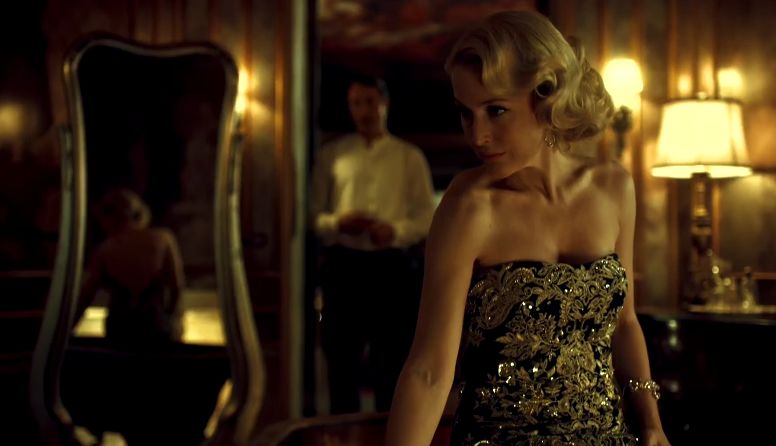
Hannibal, the man, is a construct. A series of elegant puzzle-box layers surrounding an unspeakable core. He is all artifice, all facade. Red Dragon gives us a killer who is the opposite: all emotion, all pain and id and physicality. That’d be Francis Dolarhyde (Richard Armitage), dubbed “The Tooth Fairy,” who murders happy families. A man so bizarre and inhuman that only two men and one blind woman can make anything out of him. The men are Will Graham and Hannibal himself. Three years have passed and Will has fooled himself into thinking he’s normal again. He has a wife, Molly (Nina Arianda), who nurtures him while knowing in her heart she’ll never quite have him. Hannibal, meanwhile, previously gave himself up to the FBI for shits and giggles, and now resides in prison under the cold, watchful eye of his onetime lover, Dr. Alana Bloom (Caroline Dhavernas). Hannibal’s cell is more like a vast, luxurious study; even in captivity, he requires comfort. Jack Crawford wants Will to assist on the Tooth Fairy case, and Will is yanked back by the hooks still buried in his psyche.
The Red Dragon arc has a lot of ground to cover. It hits all the beats from the novel -- the tiger, the flaming wheelchair, the dentures -- and at times it felt like a checklist. The show continues its knack for surprising Lecter fans, often by swapping out one character for another. Alas, that Red Dragon couldn’t have taken up an entire season, a recurring tale mixed in with other material for thirteen episodes. Instead, Hannibal returned to its crime procedural roots somewhat, while also running with its dream-images of grisly beauty; it gave us the best of both worlds. You see, Francis Dolarhyde is transforming in his mind, giving way to an entity inspired by William Blake’s watercolors of a savage and sexualized dragon-man. Armitage, best known for playing Thorin in the Hobbit trilogy, portrays Dolarhyde as a man attempting to move and speak through constant, excruciating pain -- the pain of being a monster in human skin. He has a raw beauty (he looks a little like Robert Patrick’s T-1000) and a haggard, harelipped scowl, and in his debut episode, he conveys all we need to know without uttering a word. He thinks he’s impregnable, until he meets Reba (Rutina Wesley), the blind woman, who refuses to judge him. The possibility of love and tenderness cracks Dolarhyde’s human suit before he’s ready, allowing Will and Hannibal to slither in.
All things come back to Will and Hannibal; Dolarhyde is simply a catalyst to bring the two star-crossed antiheroes back into each other’s orbit. Hannibal has less to do in these episodes; cozy in his cell, he pulls a string here, nudges a chess piece there. Will, Crawford, and Alana find themselves scheming amoral schemes in dim rooms, and Will comes to accept he’ll never be free. He was doomed from the moment Hannibal saw him as more than a curiosity. But how does it all end? Oh, it ends. The season/series finale is an ending, to be sure. It could also be a beginning. The Red Dragon arc abandons the source material to focus on its three main players, and what follows can only be called a consummation of sorts. I won’t spoil it. But it puts Will and Hannibal in a place from which they may never need to return. And it finally, finally, allows Will a position of dominance, of control. Meanwhile, we get more-or-less satisfying cap-offs for other characters, including a truly shocking and pitch-perfect revelation concerning Dr. Bedelia du Maurier. The show even continues the dark running gag of inflicting copious bodily harm on sleazy Dr. Frederick Chilton (Raúl Esparza) without actually killing him. Dry chuckles. (In the book, tabloid journalist Freddie Lounds meets a ghastly fate; on the show, Lounds, gender-swapped and played with amoral relish by Lara Jean Chorostecki, was too good a character to sacrifice.)
Yes, the ending is an ending, and still, Will’s final decision is sure to be debated. (And the post-credits scene with Bedelia may be dismissed as a tease for a phantom Season Four, but still wraps up her character pretty well, when you think about it.) I will wait for more forays into this universe, but in the meantime...thank you, Bryan Fuller, for never, ever compromising. Thank you for using your final season to craft two very different, sumptuous tales -- even if you did rush the story along in the process. And thanks to the cast! Mads Mikkelsen and Hugh Dancy have woven the narrative around their relationship and will always be linked in my mind. I love how Laurence Fishburne took Jack Crawford from angry doggedness to bitter acceptance of man’s evil. I appreciate Dhavernas’ Alana Bloom, who was really annoying in Season Two (“I am sleeping with him, therefore I refuse to hear a word against him! BAWW!”) before undergoing a killer metamorphosis. And I have plenty of affection for those two wiseass forensics guys played by Scott Thompson and Aaron Abrams. (They have names, but from the beginning, I have lovingly thought of them as Thing One and Thing Two.) Finally, I tip my hat to the late, lovable Beverly Katz (Hettienne Park); I hope your thinly-sliced corpse turns up in a modern art museum.
Thanks to all. And I will wait patiently until the players find a time and a place to reassemble. In the meantime, my consolation prize: Fuller is working on the American Gods TV show, a project which has my full attention. He’s going to make it beautiful and epic, and, God, do I hope it won’t sink in the tide of bullshit on TV. Yes, I am grateful that Hannibal got three seasons when it could have only gotten one. Yes, its story can be over. But it doesn’t have to be. A show this unique, this ambitious, defies TV Land. Wait with me. Sit at the table and chat with me while the next course is prepared. It takes a long time to make a meal, but the result is all the more mouth-watering.
A toast to Dr. Hannibal Lecter. Long may he simmer.
Monday, August 31, 2015
Saturday, August 22, 2015
ABCs of Death 2
My, my. I have been looking forward to this.
Back in 2013, I wrote a post about The ABCs of Death, an anthology of (mostly) horror-themed short films. I found it to be quite enjoyable, albeit with deeply unreliable quality control. Some of the shorts delighted me, some were “meh,” and others made me want to track down the filmmakers and stick their heads in urinals. I guess it’s inevitable that this concept become a franchise, so here we have ABCs of Death 2! Yes, I’ve been excited for it, but also nervous, because the law of diminishing returns almost always applies to horror film series. To my wonderment, ABCs of Death 2 is at least as good as its predecessor and possibly better. I bet the latest brat pack of filmmakers used the first film as a guide for what not to do; there’s less tedium, less “meta” bullshit, less poop jokes, and more clever ideas. Why, I hardly hated any of the entries! Certainly nothing ruined my good mood like the piss-awful “T is for Toilet” from the first film. Progress!
So. Once, again, 26 directors (or directing teams) from all over the world are given a letter of the alphabet and tasked with crafting a bite-sized film of five minutes or so, dealing with death and/or horror. No rules beyond that! This series may turn out to be a godsend for all the aspiring filmmakers whose names and filmographies I cannot be arsed to look up. Let’s break down the deadly twenty-six!
SPOILERS may follow.
A is for Amateur
The anthology begins at quite a clip! We find ourselves in a neon, modern-day Noir-verse as a bearded assassin sets out to bag his target. But, as with many of these entries, there’s a twist: we get a montage of the assassin seemingly making the kill, and then the film backtracks to show how, in reality, he royally fucked up. The frenetic editing confuses, but serves to set up the blackly funny payoff, and the alphabetic title (which comes at the end) makes us chuckle. B+
B is for Badger
A newly-built chemical plant is wiping out the local badger population? Wherever might this be going? Not to creature feature gold, I fear. It was a nice move to feature an obnoxious nature show host, but we know exactly where the story’s going (nom nom!) and when the money shot comes, it’s disappointingly low-budget. My thirst for mutant badgers is unquenched. B-
C is for Capital Punishment
See, I much prefer it when a film, even a gory one, aims to do more than shock. In this case, no dice. A kangaroo court of angry men plans to execute a guy they think is a murderer, but when the victim turns up alive, can they abort the beheading? No happy ending ensues. It’s too gory and too nasty-spirited, and has no point beyond gore and nasty spirits. C
D is for Deloused
I won’t bother trying to explain this one, because it doesn’t try to make sense...but it’s freaky and brilliant. Depicted in eerily fluid stop-motion animation, it opens with a man murdered by undead captors, but I’m only scratching the surface. A sentence like “There’s a clown-faced demon in the giant louse’s anus and it eats heads” sounds like William S. Burroughs’ darkest, druggiest ramblings. But there it is. A short film this unsettling and surreal doesn’t leave your thoughts quickly. A-
E is for Equilibrium
A pair of shaggy-maned louts are shipwrecked in paradise and living the carefree life. A beautiful woman washes up on their beach and teaches them some manners, but then the triangle erupts into jealousy and violence. This is presented as a comedy, but the final scenes are honestly kind of sexist, albeit in a self-aware manner. Maybe. B-
F is for Falling
Not a horror film, more a statement. A female Israeli parachutist is stuck in a tree and pleads with a gun-toting Arabic youth. Things don’t go well, and although the ending surprises, it leaves you feeling kind of sad. But is that all it’s trying to say? That the strife between Israel and Palestine is sad? We knew that already. This one needed to either take its concept further, or leave out such an obvious “moral message.” I believe it would have had greater impact. B-
G is for Grandad
What a weird little film this is, in part because both its stars have random Axl Rose haircuts. They are a snobby young man who’s living with his grandfather, and said grandfather, who seems stuck in the past but has sinister designs on his grandson. It’s all a bit muddled; we just want to see the young douchebag get his just desserts. We do, along with a pointless final “shock.” Sleepaway Camp did it better. Next. C+
H is for Head Games
Bill Plympton is an animator whose obsession with facial trauma is prominent here. In his instantly recognizable style, we see a man and woman kiss...which turns into a full-fledged war between their facial features. And I mean WAR, quite literally. It’s creative enough, although Plympton already used this premise with his 1988 short, “How to Kiss,” and it worked better then. B
I is for Invincible
This one tries too hard. A bitter group of grown siblings attempt to murder their mother for her inheritance, but nothing will kill her -- not stabbing, immolation, or decapitation. It’s implied that the poor woman’s under a curse of some kind, and I wish they’d developed that idea more instead of just flinging fake blood everywhere. The Gothic imagery is cute, but not redeeming. C-
J is for Jesus
Did I say “tries too hard”? Change that to “tries so hard it suffers a hernia.” Fuck, is this heavy-handed. A gay man is bound and subjected to a rabid Christian exorcism. Want more? The victim displays stigmata, his captors have demon faces, and then his murdered boyfriend returns as a ghoul and kills them. Boo hoo, religion sucks and gays are persecuted. Yes, I myself am gay. That doesn’t mean I like being hammered over the head with childish depictions of homophobia. The cure is more love, not ghastly revenge fantasies. Fun fact: Some guys I know from high school submitted a film, “M is for Messiah,” in which a guy was eaten by zombie Jesus. I’d rather have watched that. D
K is for Knell
But what’s this? A genuinely scary and well-made entry? Yay! It’s my favorite of them all. A woman witnesses an oily black orb appear in the sky, turning everyone around her into murderers. It’s beautifully shot, with outstanding use of color and an eerie sound design. It’s mysterious, but has no need to explain itself. There’s something about Eastern Europe that seems to inspire great horror filmmaking (see also: “R is for Removed” from the first anthology) and this is no exception. A+
L is for Legacy
I was happy to see this one here, because African filmmaking is too often overlooked. That said, I was unable to follow the plot. I guess it’s about a human sacrifice that goes awry and summons a demon, but I’m not too sure. Most of the dialogue’s in English, to no avail, and the ending is botched. Still, its old-school special effects and bold visual style win points, and remind us that making movies is not a first-world exclusive. B
M is for Masticate
This one’s stupid, yet oddly lovable. For most of the film, a hairy guy with freaky eyeballs and pee-stained Tighty Whities is barging down the sidewalk, randomly assaulting people -- in super slow motion! I will say that the short has a great sense of timing. It’s obviously a joke, and the punchline will make you roll your eyes. (Hint: What freaked us all out in May of 2012?) I guess if you’re gonna be juvenile, go for broke on style. B+
N is for Nexus
Two Gothy types hurry to hook up on Halloween, and, along with a few other characters, hurtle towards a lethal traffic accident. I bestow the “style over substance” label upon this entry. Everything foreshadows the accident, and then the accident happens, the end. A story needs more than that. However, the filmmakers make good, creative use of camera mounts and editing, and succeed in making Halloween itself look grungy and unnerving. B
O is for Ochlocracy (mob rule)
You shouldn’t need to explain your title. Still, this entry comes bearing a great idea. A zombie plague hits Japan, a cure is discovered, and the zombies put the non-zombies on trial for the “murders” they committed during their survival. I believe this might actually happen if a zombie outbreak occurred, and the short wisely lets its premise do the talking, no gimmicks needed. It’s both funny and horrifying. A
P is for P-P-P-P SCARY!
Fuck that title. I hate that title; it’s the world’s biggest cheat. The film ain’t bad, though. It pays tribute to early-20th-century comedy, shot in purple-tinted monochrome and starring a trio of stuttering, beaky-nosed jailbirds who have escaped. They encounter a man in the dark...but is he a man? I won’t spoil what happens, but it manages to be surprisingly creepy, given the overall humorous tone. A worthy homage indeed; I just HATE THAT TITLE. A-
Q is for Questionnaire
A lot of these entries have top-notch editing, and “Q” is no question. A guy falls victim to one of those “Instant Intelligence Tests” under a pop-up tent on the sidewalk. And “falls victim” is the right term; the man’s test is intercut with him having his brain surgically removed. For science? You’ll see. Besides the good editing, this one’s got a good soundtrack, with the victim’s horrid fate punctuated by the happiest, jauntiest music that ever felt totally inappropriate. A-
R is for Roulette
Three people sit in a basement, in formalwear, playing Russian Roulette. It’s a mysterious premise, and we spend the runtime waiting for the solution. When it comes, it’s maybe too obvious, but still neat. A pretty basic entry that features good acting and very good tension. B+
S is for Split
Oh, man, another good idea brought to amazing life. We’ve got a guy in France calling his wife at home in England, and their chat being interrupted by someone breaking into the house. The filmmakers use split screens to show us the husband, the wife, and the intruder simultaneously. I love it. The style would have been enough, but the plot also throws a couple killer twists in our face. I wanted to howl with glee at the final reveal. I’d watch a whole movie like this! Make it happen? Please? A+
T is for Torture Porn
...But not how you picture it. We see a sleazy porno audition, a lovely woman being treated with casual cruelty by the male film crew. Will the creeps get what’s coming to them? Yes, they will, but their exact fate is, shall we say, vague. This concept has been done plenty of times before, and better. Bonus: Sit through the anthology’s end credits to see a “continuation” featuring The Human Centipede’s very own Laurence R. Harvey! Uh.....yay? C
U is for Utopia
All together now: The future is cold and loveless, everyone is beautiful, and the imperfect are horribly persecuted. It’s every dystopian sci-fi ever, and here it goes again. However, the lack of originality is made up for in stylish filmmaking, as well as the disturbing fate of the poor schlub who doesn’t fit in with the Barbies and Kens. They didn’t reinvent the wheel, but they gave it a good polish. B+
V is for Vacation
This one’s a lurid and sorta interesting “depths of depravity” study. Shot entirely via smartphone, it features a guy calling his girlfriend from his sexy vacation spot. Then the guy’s drugged-up buddy snatches the phone and shows the girlfriend what they’ve been doing for fun. It’s cruel, its last-minute descent into bloody murder feels forced...but I can’t deny it’s effective at being distasteful. B-
W is for Wish
I laughed at this one, then felt a tad guilty. It begins as a 90s-style commercial for action figures, starring two bright-eyed boys who long to enter the toys’ world. They do, and discover it to be a grisly, violent war zone that only becomes more fucked-up. That’s the joke. Are ya laughing? I did laugh, as I said, so I suppose this succeeds, even if it’s sooooo mean. B+
X is for Xylophone
I imagine a lot of hair-pulling from whoever gets assigned the letter X. These guys just said, “Fuck it,” and went with the most obvious X-word. The result? A cute little girl whales on a toy xylophone, to the agitation of her grandmother, who looks like Wednesday Addams going through menopause. The moppet meets a grisly fate, and the film ends on a sustained note of...well, it’s more awkward than horrific. “Hey, look, gore! Can we be done now?” C+
Y is for Youth
I worried the anthology would pass by without any Japanese weirdness. Last-minute save! A teen girl composes angry texts aimed at her dysfunctional mother and stepfather. Her words become trippy revenge fantasies in which the adults are murderized by their own mistakes. Mistakes such as a giant hamburger monster. Just roll with it; it’s so bizarre and random that it passes tasteless and arrives right back at entertaining. Thanks, Japan. B+
Z is for Zygote
Unlike the first ABCs of Death, this one actually ends on an awesome entry! A man leaves his pregnant wife alone with a medicinal root that will delay childbirth. Thirteen years later, the husband isn’t back and the woman has a cheerful adolescent child...who is still trapped inside her womb. This fairy-tale-from-hell logic leads to one of the goriest scenes I’ve ever witnessed, but the film manages to be touching despite the body horror...and then ends on a note of sublime creepiness. Bravo! When they make the next one, whoever gets Z should watch this and take notes. A
And I’m sure they will make another one, because The ABCs of Death has turned out to be a gift that keeps on giving. I have no doubt they’ll find more filmmakers eager to put their visions up! I will happily keep watching, because this sequel quite possibly topped the original. Though I will dock points for its annoying theme song (a creepy little kid going “lah-lah-lah” for about eighteen fucking hours), which got super old as I sat through the credits to see if that really was Tom Felton in the “C” entry. (It wasn’t. Duh.)
But who cares about framing devices? Gimme more horrific and creative short films! Bring ’em on! Now I know my ABCs; next time won’t you scream with me? There, I wrote the third film’s tagline.
Tuesday, August 4, 2015
Myst Series, pt. 9
Daymare Town -- Unwanted Souls Down an Uncharted Street
Picture a map of all the games you like. An atlas with land masses, oceans, towns and cities. Ignore that each game exists in its own universe; mash them up. Here’s Raccoon City. There’s Midgar, on another continent...and over there, the ruined vistas from Gears of War. Look up on a clear night and you’ll see Rainbow Road. Now, turn your eyes across the sea. Somewhere out there is the archipelago that make up the Myst series. Myst Island, Riven, Tomanha, Serenia and its stupid hippie mushroom tombs -- they’re all accounted for. But a map has edges. What’s past them? What exists where the video game atlas goes blank?
Maybe it’s Daymare Town.
Once again, we’re diving into the mind of Mateusz Skutnik, Polish artiste of many mediums. You may remember my post about Submachine, an incredible little game series that may be reaching its conclusion soon, although it’s the sort of project that never quite ends, or shouldn’t. Skutnik’s done plenty of other stuff, and I’ve been wanting to discuss my second-favorite game series of his, Daymare Town, which you should totally check out and play. For free. Or buy it, because supporting artists is a good thing to do. Especially when they can create something so weird, eerie, unique, and impossible to forget once it’s over. When they fill in that blank space on the map, banishing the void with ink and whimsy. And bad dreams.
The Submachine games are not known for their bright colors, but they’re freakin’ Katamari Damacy next to Daymare Town, which takes bleakness to a whole new level. It’s a world of scribbles and shadows on an off-white background, like doodles in an old sketchbook, which may well be where it began. Once again, we have the profound sense of isolation that characterizes much of Skutnik’s work. His worlds are lonely...but Daymare Town itself is far from uninhabited. You’re never alone, but you never feel welcome. Daymare Town is composed of narrow, crooked buildings with yawning black entrances. The town’s inhabitants tend to be small, furtive, tangle-haired homunculi, though many of them defy such an easy description. They regard you with suspicion, and while some of them can help you, none of them are your friends. There’s no music here, just the howl of wind. And there’s only one goal: to leave. Find the exit. How hard could it be?
The gameplay of Daymare Town is very familiar. Simple point-and-clicking from screen to screen, as you collect items that you’ll use elsewhere to open new pathways, or solve the very particular problems of the townsfolk -- a thankless job. I would not call the gameplay flawless. As with many adventure games, these fall victim to Skutnik’s particular brand of logic. Just like in Submachine, or the Myst series, this world defies conventional reality. You can step inside a painting, conjure a hot-air balloon from thin air, summon a skeletal giant from the desert sands, you name it. This is all wonderfully fantastical, but it makes a lot of the puzzles deeply illogical, until -- you guessed it -- there’s nothing left but to try rubbing every item on every potential item-using-spot. There’s also a bit of pixel-hunting -- meandering the cursor all over the screen to try and find stuff -- but because the art style is so minimalist, it’s rarely difficult to miss even little things like coins. Still, making it through the Daymare Town games without consulting a walkthrough is...impressive.
I don’t mind. The atmosphere is what matters. Daymare Town is a very creepy series. It’s nothing like a conventional horror game, but it gets under your skin. A lot of it seems inspired by vaguely Scandinavian folklore, gnomes and trolls and the like. Maybe Daymare Town is where bad little boys and girls are sent when they don’t eat their asparagus. The first game plunks you down in the titular town and all you can do is begin to explore, to creep into the slanted, skewed buildings and find what you find. Who are you? How did you get here? These questions may have answers (the protagonist is eventually revealed to be a black-clad chap with haggard features; Roland Deschain, is that you?), but Daymare Town defies all explanations. Once you “escape,” you merely find yourself in Daymare Town 2, yet another labyrinth of streets, mocking you. Sadly, the series got more complicated than it needed to be. Daymare Town 3 is quite ambitious, introducing a tedious mercantile system and sidequests. I normally love sidequests, but in this case, they’re way too hard to grok (poison the guard captain? Why the fuck would it occur to me to do that?), and it’s impossible to do them all anyway because two of them require the same item and there’s only one such item in the whole game. My anal-retentive side screams in anguish at such oversights.
Daymare Town 4 is pretty cool, though. It takes you out of the town and into a wasteland of cliffs and dunes. It’s more fantastical than the previous three, and more detailed, and I love imagining Skutnik hunched over his drawing board (or his tablet; let’s be realistic here), conjuring such unforgettable places and creatures. There are more sidequests, and way more items than you’ll actually need, but while the third game committed the cardinal sin of a limited inventory, the fourth one hands you a gigantic backpack that can hold all the useless junk for you. Of course, sifting through the junk, trying to find the items that actually matter...not so great. I still say these games could benefit from better puzzle logic. But, then, logic has no place in Daymare Town. It’s devoid of context. It just is. If the Submachine was a dumping ground for all things forgotten, Daymare Town is the repository for everything, and everyone, unwanted. And you yourself don’t want to be there, because once you become a citizen, you’re trapped. You’ve lost yourself, just like all those scampering, trollish little wretches that lurk in the alleys and doorways.
Games like this evoke so much, and I wish I had a fraction of Mateusz Skutnik’s talent when it comes to creating worlds. What Daymare Town lacks in coherent gameplay, it makes up for in vision. Yes, it gets frustrating when you’re stuck in a rut and nothing in your inventory seems useful. I can’t always claim that playing these games makes me happy. (Except maybe for Daymare Cat, a spinoff platformer that weaves the austerity into joyous music.) But everything about them entices me. I can’t help being attracted to the blank space on the map, and wanting to help fill it in. That said, I’m glad Daymare Town isn’t real, because such a joyless, freaky, cryptic labyrinth of lost souls should not be wished on my worst enemies. Except maybe for that one guy. Fuck that guy. I’d send him to Daymare Town and let the shadows devour him.
Not you, though. You’re cool. And that’s why I invite you to appreciate the games I love. Wander my map.
Myst Review Series
Myst • Riven • Myst III: Exile • Myst IV: Revelation • Submachine • Kairo • The Talos Principle • The Dig • Daymare Town • Fez • Tri: Of Friendship and Madness • The Witness
Friday, July 17, 2015
To Squee Or Not to Squee: Hannibal, pt. 1
PART ONE: FLORENCE
It’s time to fine dine on some Cautious Enthusiasm.
To begin with, let’s all agree that writing about Hannibal in a manner that does it justice is next to impossible. This TV drama cannot truly be experienced secondhand; it must flicker before the eyes and whisper its music in the ears. It’s easy enough to describe what it’s about on the surface. It’s about Hannibal Lecter, our most beloved of fictional serial killers, and his relationships with the various people in his orbit, or on his dinner table. Really, though, the plot is a thin layer of infused oil floating atop a deep, rich, nuanced roux of mystery ingredients. After two-and-a-half seasons, I’ve come to accept that nothing in this show can be taken at face value. It runs on dream logic. It is not set in our world. Movies depict versions of human society where superheroes or monsters or giant robots exist and are simply accepted in day-to-day life. Hannibal is like that, but its world crawls with theatrical killers, people who turn people into gourmet dishes, or craft corpses into totem poles, or bury their still-living victims to nourish mushroom gardens. And it’s not enough to call Hannibal Lecter their king. He is their god. An avatar of controlled chaos.
Writing about the third season of Hannibal would be very different if this weren’t also its last season, maybe. The show has been canceled by NBC, a guillotining as dismaying as it is probably inevitable. Hannibal was never going to pull in the crowds. Bryan Fuller doesn’t make crowd-pullers. He doesn’t stoop. The fanbase is small and fervent, pruned over time as “normal” folks stumble away, mewling that it’s too weird, that they can’t handle all the hoity-toity psychobabble, that only freaks want such an ornate parade of carnage and guts. They may be right. I’m proud to be a freak, and so are the people who make Hannibal. Possibly guessing that Season Three would be the swansong, they turned it into a cry of defiance, diving deeper into their trademark use of slow motion, macro closeups, surreal special effects, discordant music, and the repurposing of gore as high-class theater. They’ve also ventured further into the show’s central coupling, that of Hannibal (Mads Mikkelsen) and FBI profiler Will Graham (Hugh Dancy), who circle each other with helpless fascination. And, to ensure the show’s budget reports would burst some capillaries in the NBC offices, they went to Italy.
For the uninitiated, there are three Hannibal Lecter novels by Thomas Harris: Red Dragon, The Silence of the Lambs, and Hannibal. (There’s also an origin story, Hannibal Rising, but let’s not count that. Please, God, let’s not count that.) So far, the TV show hasn’t really sunk its teeth into the novels. Its first two seasons masked themselves as police procedurals, a string of case-of-the-week killers to appease the mainstream while the show quietly developed its themes of obsession, madness, love, death, and betrayal. And now the books, right? Well, yes, but they decided to bump the novel Hannibal up the ladder of their chronology. These first seven episodes of Season Three find Hannibal hiding out in Florence, accompanied by his therapist-turned-accomplice, Bedelia du Maurier (Gillian Anderson). Florence, that most beautiful of cities, here turned into an echoey mixture of postcard and necropolis. In the Season Two finale, Hannibal left most of the main cast horribly wounded in body and soul, and his living victims remain drawn to him, one way or another. Will Graham seeks, not revenge, but some sort of affirmation he can’t define. FBI boss Jack Crawford (Laurence Fishburne), retired and bereft, craves closure on the case that has dogged him for years. Mutilated billionaire sicko Mason Verger (Joe Anderson) just wants Hannibal’s balls on a platter, possibly literally, and orchestrates a conspiracy to snatch the fugitive. But what does Hannibal want? Wisely, the show leaves him an enigma. Elements from his backstory are alluded to; Will visits the old Lecter estate in Lithuania and recruits Chiyoh (Tao Okamoto), a former handmaiden who remains quasi-willingly under Hannibal’s long-distance influence. But Hannibal himself skates over the needs of normal humans.
It’s all beautiful, sometimes too beautiful. The Florence arc is not my favorite thing Hannibal has ever done. Nothing may ever top the last two-thirds of Season Two, which featured a dazzling game of intrigue and treachery that blindsided us with shocking, delicious surprises each week. Having surgically removed itself from any conventional narrative, the show leans so heavily on its slow, elegiac pace that some episodes fall short of complete satisfaction. Yes, even as a devout fan, I don’t always want to spend thirty seconds staring at slow-motion liquid physics while kettledrums thunder on the soundtrack. Somehow, the plot seems to hurry unduly despite the visual sluggishness. They could easily have spent an entire season on Hannibal-the-novel. Were they eager to cram before NBC pulled the plug? Ah, well, a weaker Hannibal-the-show is still unparalleled, and they can still blindside us. I’d felt anxiety about how they’d adapt one of the novels for the first time; so many of us know what’ll happen already, so can we still be surprised? Oh, yes. They hit all the major beats: the fate of poor Inspector Pazzi (Fortunato Cerlino); the ghastly dinner date where Hannibal slices off somebody’s skullcap to sup on their brains; the showdown at the Verger farm, where Mason gleefully plans unspeakable torments. But none of these events are as we expect; they are lifted, turned about, and studied from a different angle, to amazing effect.
The catch, of course, is the gaping hole where Clarice Starling should be. The show does not have the rights to that rather crucial character, but their strategy is to have other characters stand in for her in unexpected ways. Best of all is Bedelia, who is played with incredible precision and subtlety by Anderson. Here is a woman who is equal parts horrified and fascinated by Hannibal Lecter, and observes him with one eye on her own survival, flirting with danger just because she can. She is the best female character the show has given us. Ah, but what matters is the love affair between Hannibal and Will, and Season Three contains all the romantic tension we could hope for. To call their relationship “homoerotic” is to miss the point; their strong attraction is, if not sexual, certainly sensual. (Will in Season One: “Did you just...smell me?”) Dancy plays Will as a man who doesn’t like other people, and who finds in Hannibal a creature he can love and hate in equal measure. As for Mikkelsen, well, he ain’t Anthony Hopkins, and that’s a good thing. This version of Hannibal has yet to taste captivity, and doesn’t feel the need to entertain. No, we’re his entertainment. It’s telling that when Hannibal is at Mason Verger’s mercy, he seems delighted, consumed with interest in his own impending fate. Humans fear death, and Hannibal is only human on the surface.
The first half of Season Three begins slow and picks up pace, culminating in a fateful collision, a serving of just desserts that is expected but welcome. But what of Hannibal’s capture? In Red Dragon and The Silence of the Lambs, he’s locked in a cell, an exhibit for doctorly types to pore over, little realizing how free his mind remains. The show has teased us endlessly; Season One ended with Will on the chopping block for Hannibal’s crimes, while Season Two gave us a blood-drenched escape. And now? Well, I guess I can spoil that Hannibal is, quote-unquote, “caught.” But it remains to be seen how much control he still wields over his situation. His seeming downfall becomes an act of triumph, and not for the FBI. As with everything else in this show, it’s a familiar trope made new and intriguing, given layers of internal logic, of motivation. This Hannibal Lecter always seems several steps ahead, as if he’s learned to live outside linear time. He can reach back along the path he’s carved through civilized society, yank on any tendon, drag any pawn back onto the chessboard. The next six episodes will tell the tale of Red Dragon, and although I have read the book and seen the film, I have absolutely no idea what to expect.
Will it be the end of Hannibal, or will Fuller find a new distributor and/or a new medium in which to present his visions? I refuse to believe this is it. Hannibal himself would never be satisfied. This is a multi-course meal; how could we leave in the middle? Rude. I’ll check back after the Red Dragon arc, and Season Three, conclude. I have more to say, more to digest. Hannibal isn’t just a meal, it’s a drug. There’s nothing else like it on television. I still hunger.
UPDATE: Read on...
Saturday, June 13, 2015
Top 10 Childhood Terrors
Let this blog post serve as a grave marker. An epitaph. To what might have been. To the real horror, the horror of seeing something promising disappear under a mountain of bullshit. I refer, of course, to Silent Hills, about which I wrote many, many words (I was pretty much drooling on the keyboard) before it was unceremoniously canceled due to some falling out or other. Guess we’ll just have to wait and see if they dig up Silent Hill again...ever.
Meanwhile, to prove how amusingly subjective fear can be, here’s a list of things that scared the ever-loving piss out of me when I was a kid. You look back on this stuff and chuckle. Or, in some cases, nod and say, “Yeah, I was right to be scared, that shit’s still pretty freaky.”
DANG-BLASTED’S TOP TEN CHILDHOOD TERRORS
All Dogs Go to Heaven
Case in point. Why the fuck is this even considered a children’s movie? Re-watching it for the first time in aaaaages, I came to suspect that child therapists have entire file cabinets devoted to Don Bluth. Look, a cute doggie who is also an alcoholic creep and who gets MURDERED ten minutes in. Who, at one point, goes to Hell, where he’s terrorized by fire, skeletons, and demons. Meanwhile, the villain, Carface, is truly the Boogeyman in bulldog form, what with his child kidnapping, murder, arson, cigars, and tying the hero to an anchor so he can slowly drown. An adorable little girl suffers PTSD-worthy levels of peril, and the fun-loving sidekick is savagely beaten by thugs, and...weirdly enough, the one part of the movie I could not watch as a kid was the campy singing alligator bit. I know, right? I hated that gator! He ate people! Fast-forward! But, really, the entirety of this film is one long Bosch painting. Which actually makes it kinda cool, huh?
Borrowed Black
I wouldn’t be surprised if no one reading this knows what I’m talking about. If you do, awesome, you encountered the same sanity-wrecking children’s book as me! My dad read me Borrowed Black and it messed me up for weeks. Set on the coast of Labrador, this freaky fairy tale stars the creepiest of all creepers, Borrowed Black, a...man-like thing...whose body is constructed entirely from bits and pieces he “borrowed” (stole) from other creatures. He steals the moon one day, casting the land into darkness, prompting some talking animals to save the day. All this is depicted in bleak, monochromatic illustrations that quite literally popped up in my nightmares. Again: who dreams this up and thinks it’s for kids? As an adult, I tracked down Borrowed Black and found that the heroic animals are gratuitously whimsical and the rhyming prose is clunky. But he’s still there, the patchwork demon staring into my soul. Borrowed Black was my Babadook.
Doctor Who vs. Vampires
This one is vague, a shadow from the past, and pretty silly. One day at my grandparents’ house, I found myself watching an old Doctor Who episode with Tom Baker. Bless the internet for allowing me to pin stuff like this down! The ep, I now know, is called “State of Decay,” and in it, the Doctor battles medieval-styled vampires. I couldn’t tell you a damn thing about the plot, but I remember the images that freaked me out. Images like a woman lying helpless while bats bit her neck. Or a giant hand (some kind of final boss vampire) bursting from the ground. The special effects were terrible, of course, but children don’t notice that sort of thing. You tell a little kid there’s a giant vampire clawing his way up from underground, they take it at face value. It haunts them. Today, I don’t give two shits about Doctor Who, but show me Baker in his hat and scarf and I’ll instantly go, “Yep, that’s the one who gave me childhood heebie-jeebies. Jerk.”
No Jumping On the Bed!
A few years back when I found Tedd Arnold’s No Jumping On the Bed! at a book sale, my heart swelled with joy, because I could finally make peace with the scariest picture book from my childhood. This “cautionary” tale stars a kid named Walter who loves to get some serious air time on his mattress. One night, he jumps so high and lands so hard that the bed breaks through the floor...and proceeds to crash through every floor of his apartment complex, picking up more and more people, animals, furniture, and random items. The presentation is in no way scary (the characters seem rather amused by their downward journey), but when I was little...you have no idea. Walter’s act of property destruction was the most horrifying thing I could imagine. I’d stare worriedly at the ceiling in public settings, wondering if a bunch of people and furniture were about to crash down on my head. I never entirely got over the dread...well, until I found the book again and chuckled at how benign it really was. I think there’s a sequel where Walter floods his bathtub and...actually, don’t tell me. I don’t want to fucking know.
Peter Pan (The Parts with Kidnapping and Bombs)
We all know Disney is dark. While Mufasa’s demise certainly left me an unhappy camper, the Disney flick that I owned on VHS was Peter Pan. Nobody dies in Peter Pan! But there are some close calls. Basically, an entire stretch of the film, I couldn’t watch. Had to skip it. It begins when Wendy and all the boys get kidnapped by the pirates, after which Captain Hook tries to reduce Peter Pan to gravel with a bomb disguised as a present. Tinkerbell saves Peter’s life but is herself blown up, and the movie tactfully doesn’t show her gruesome, well-mangled little fairy body, but you can imagine. Meanwhile, Wendy has to walk the plank while her little brothers watch. Dafuq kind of fetish does this movie have for drowning girls? Needless to say, Peter saves the day and everything is fine (Tinkerbell’s miraculous recovery from FUCKING EXPLODING is expertly glossed over and ignored). So if you skip all the scary, kids-in-mortal-peril shit, it’s like it never even happened! You do miss the cool pirate song, though.
Peter Rabbit (and Farmer McGregor)
This might be the oldest childhood fear of mine, since I barely remember it. But my mother can fill in the details of my meltdown. Beatrix Potter wrote a lot of weirdly downbeat books about cute talking animals, starting with Peter Rabbit, who was really a disobedient little punk for sneaking into Farmer McGregor’s garden to pilfer veggies. As a tot, you naturally root for Peter, and in my case, it helped that I found Farmer McGregor unbearably scary. Something about his face...about the way his opaque glasses and Santa Claus beard obscure his features, turning him into an implacable force for murdering underage bunnies. My mother remembers one image in the book, a closeup of the farmer’s face searching for Peter, that made me wail and hide under the blankets, unwilling to continue being read to. I also had the story on tape, and listened to it a lot, despite my dread. I guess even at the age of...what? Three?...I was interested in what scared me. Farmer McGregor and his blank, judgmental glare were only the beginning.
Rikki-Tikki-Tavi
MOTHER. FUCKING. COBRAS. Other kids think there’s a monster under their bed. I kept my limbs tucked in so I wouldn’t be bitten to death by evil cobras. Thanks, Rudyard Kipling, for trolling the children of the future with your messed-up jungle stories. I never read the original Rikki-Tikki-Tavi. Nor did I ever see the 1975 Chuck Jones cartoon. No, I owned a picture book based on the cartoon. And that was more than enough. If you don’t know, it’s about a plucky mongoose who must defend a missionary family from malevolent cobras. In the cartoon, the cobras are kinda goofy to me now (Chuck Jones characters tend to look like their cheeks are stuffed with maple syrup), but in my early years, I stayed fetal in my little bunk bed (I was an only child; the upper bunk was for my stuffed animals) because I absolutely knew that Nag and Nagaina were slithering down below, waiting. And I had no mongoose. Why didn’t I have a mongoose, DAD?
Scary Stories to Tell in the Dark...On Tape!
Well, duh, my entire generation got scared by Alvin Schwartz’s trilogy of spooky tales. And we all know why: it was the smeary, terror-dripping illustrations fever-dreamed up by Stephen Gammell. The penetration of Scary Stories into our zeitgeist is quite remarkable, as evidenced by how furious everyone got when Scholastic changed the art on us. And here’s what’s funny: yeah, Gammell’s awful, awesome art scared me, but what really got under my skin was listening to the stories on tape. Blame actor George S. Irving, who performed the reading with almost inappropriate relish, accompanied by eerie music. I sat around the tape player with my classmates, in broad daylight, and I might as well have been lost and alone in a dark forest with...sounds...steadily coming closer. I was petrified. And is it a surprise to learn that I willingly sat down to listen to Irving moan and growl and cackle more than once? Oy.
Superman Fights a Giant Gorilla
Back in the 1940s, Superman starred in a series of cartoon shorts. One of them, Terror On the Midway, was on a VHS collection owned by yours truly. I invite you to watch it, and then tell me I was wrong to be scared as a child. Proving that it’s an awful idea to put dangerous animals in cages with fucking latches, a massive gorilla escapes during a circus and runs amok. Lois Lane is, as usual, in peril, and Superman saves the day, the end. I swear the bare-bones plot is merely an excuse for weirdly stylized, almost impressionistic visuals. Slanted angles, deep shadows, a murky red color palette...this feels, not like a gee-whiz superhero cartoon, but like an animator’s drug-fueled nightmare. Yes, it’s goofy when Superman puts a panther in a full nelson, and yes, those doll-eyed children are scarier-looking than the killer ape. But the images tap into some kind of primal dread: people can get hurt, everything can crumble and burn, and Superman might not be there in time. Y’know, for kids!
“True” Ghost Stories
If Scary Stories to Tell in the Dark didn’t scare me much, it might’ve been because I was busy being scared by a totally different set of tales. The “True” Ghost Stories books (I’d guess there’s some legal hooey behind those quotation marks) were by different authors, but I had the complete set in one anthology. Every time I read it, I wondered why I was subjecting myself to this. Jim Sharpe’s illustrations weren’t as balls-out horrific as Stephen Gammell’s, and many of the stories didn’t bother me (UFOs? Eh. Haunted dolls? Meh), but a handful of them...brrr. One particular tale, about an air force pilot who has a vision of his friend’s corpse floating in the ocean, still bothers me when I recall it. That image. That face, eyes gone white, mouth twisted into a rictus. I don’t recall where some of these scary childhood books wound up, but I know exactly what became of “True” Ghost Stories. I burned it. One dark night, I tossed it into the woodstove. I adore books, and I fucking destroyed one because of how badly it scared me. True story. Without quotation marks.
What about horror movies, you ask? Well, The Ring did scare me a bit, but I was a teen by that point, and it’d become cool to scare myself. The Ring was, at the time, unlike any horror movie I’d seen before, but the resultant tiresome onslaught of increasingly stupid J-horror remakes did it no favors. I still like it. And I still think The Thing is horrifying. And I own both these films, obviously.
Also, I got scared by Rien Poortvliet’s gnome, because I had a nightmare where he grew fangs and attacked me. And once I dreamed that my elementary school had a torture chamber in it, but I found that one more interesting than scary, so I guess that makes me a kinky bastard? Whatever. Bottom line: don’t laugh at a small child because they’re reduced to tears by something you find silly and harmless. We’ve all been there. We’ve had some visual trigger, book or cartoon or game, that awakens the terror we’ve carried deep inside ourselves since sabretooths ate us for breakfast. Even when we grow up, we fear the unknown.
And we love that.
Wednesday, May 20, 2015
Broken Age, Act II
And so, Broken Age concludes on the same mild, inoffensive note with which it began, leaving behind a legacy of.......something or other. Probably a horde of wannabes waving their own Kickstarter banners, wondering why they aren’t reaping mountains of strangers’ money. This game may be remembered simply for the stubborn goodwill of its many, many benefactors. We all helped make Broken Age happen, guys! It’s our baby! Kumbaya! I almost wish it had dared to alienate somebody. If crowdfunding is the last hope for original, creative game development, awesome, but I worry that crowdfunded games will fall into the same trap as mainstream mega-releases: comfy mediocrity in the name of never, ever causing buyer’s remorse. Only worse, because everyone who donates to a game’s Kickstarter has their own idea of what they want, and in order to please as many folks as possible, you gotta slap margarine on white bread as opposed to constructing a mighty, spicy, cheesy, saucy grinder. Maybe nobody’s stomach will be full, but we have to consider that one guy who’s allergic to sriracha!
But enough weird sandwich talk. What does Act II of Broken Age do, or not do, with its premise? I see no need to recap the entire plot; read my post about Act I for that. We left off with the predictable yet sophisticated twist that the tales of Shay and Vella exist concurrently, and that Shay’s “spaceship” is, in fact, the monster that’s been terrorizing Vella’s people. More fascinating to me was how Act I ended with Shay and Vella switching places. Vella is now trapped inside Shay’s half-destroyed ship, while Shay wanders the villages outside. What great implications! Implications that...never really go anywhere. Yeah, it’s fun to see how both environments have changed during the intermission, but it wears thin when we’re just galumphing around the same old places, talking to the same people. Act II came out eight months later than projected, and I assumed this meant the developers were cooking up something huge, for which Act I was merely a teaser. Instead they just juggled some details and called it a day. Lame.
So now, funnily enough, Vella inhabits the more interesting part of the game (Shay’s ship, which she must sabotage), while Shay’s stuck in the bland half (where he must help jumpstart a 200-year-old derelict ship). The result? Vella’s shipboard adventures became my favorite part of the entire game, while Shay’s quest is so...so...so...fucking...tedious. Good lord, what a contrast. Vella is discovering a sinister conspiracy that redefines her entire world...and Shay is purchasing a cupcake at a junior bake sale. Vella must somehow infiltrate the deepest workings of the monster-ship and bend it to her will...and Shay has to make a tree laugh. And it’s not just story-based tedium; Vella’s puzzles are interesting and well-conceived, arising organically from her circumstances, while Shay’s puzzles entail hiking all over the damn place and interacting with no less than nineteen different characters. It’s exhausting. Completing both halves of the story became a punishment-and-reward process for me: “Hey, if you make it through another of Shay’s stupid fetch quests, you can switch over to Vella for a bit! Stay strong!”
I complained that the puzzles in Act I were easy. I may not have been the only one, and boy, did the developers ramp up Act II’s trickiness. There’s that challenge I was looking for! Except some of the puzzles kinda suck, because they unfold in unfair ways. As I said, Shay’s story has to juggle a huge supporting cast, and it’s easy to forget who he’s spoken to about what...and every time he does something, he has to make the rounds again in case a new dialogue prompt has popped up somewhere. Vella fares better, and I loved one puzzle that entailed searching a room for clues, because I had to make my own deductions based on the clues and it felt great. Problem was, the game gave me a handy chart to help with the puzzle but gave me no way to fill out the chart, unless I wanted to use a Sharpie on my laptop screen. WTF? What really bugged me were instances where a clue from one environment was necessary to complete something in the other. It breaks the reality of the game! Shay may have revealed the name of his childhood plushie to me, the player, but Vella couldn’t possibly have that knowledge! And if Shay is stuck on something, do I need to switch to Vella and scan the entire ship for answers, or not? See the problem? Difficult puzzles are only fun when they don’t cheat.
In the end, puzzle deviousness aside, Act II of Broken Age is just more of the same. Yes, we learn why Shay’s space journey is a sham and why maidens are being kidnapped and so forth. It’s cool, I guess, but it felt like the developers began the game before they knew their own plot, and just made shit up as they went. When the game bothers to unveil some villains, they’re interesting enough, but they feel like they belong in a different game, or maybe one of those Star Wars novels that are now non-canon, HA HA, WE DRINK THE BITTER TEARS OF NERDS. A twist involving Shay’s computerized parents is cool, but nobody reacts strongly enough. Actually, nobody in the game reacts much to anything. Oh, hey, we sacrificed our daughters on a complete lie! Let’s fail to be shocked or guilty in any way! Shay is a vanilla cone of blandness, and the only character I gave two shits about was Vella, who retained her knack for sweetly wreaking havoc (honestly, she’s one dead family away from becoming a supervillain). Sure, I found the supporting cast amusing (I particularly liked Curtis the hipster lumberjack and the trio of dysfunctional sentient dinnerware), but none of them behaved like human beings, probably because their sole function was to require something from Shay, give him something in return, then cease to matter. What about the endgame, the point at which Broken Age might have broken free? Eh...a final puzzle that resets itself if you don’t topple the dominoes in the exact right order, and that, again, involves Shay and Vella apparently reading each other’s fucking minds. Then a heartwarming ending that completely ignores the powerful, murderous bad guys it took the time to set up. Kumbaya.
Soooo, Broken Age was fun. I liked it more than I disliked it. I’ve been criticizing it so much because I’m just so let down by how it never took its own potential seriously. Its art design is outstanding. Its voice cast are skilled. Its plot follows current trends (yay, a seemingly idyllic quasi-dystopia secretly controlled by shadowy puppetmasters!), but it threw some great details and serious twists into the mix. And if the landbound half of the game was as fun as the shipboard half, I’d have been way more forgiving. But why don’t I feel sated? Why am I left pining for more? When I played Monkey Island, a game that came out ages ago, it satisfied me to my very core. And Broken Age is meant to be the offspring of Monkey Island-style adventure games. Its technical improvements can’t mask its watery presentation, I’m afraid. I’ll play it again someday and maybe it’ll age well, but for now, it illustrates the dangers of overhype. We gave them our money and got something merely decent. Not great, not awful, just...a thing. A game. Point, click, win.
Forget.
Friday, May 1, 2015
Myst Series, pt. 8
The Dig -- A Tale of Three Idiots and Some Archaeology
I’ve known for a long time that The Dig needed to go in my Myst review series, despite seeming, on the surface, like a refugee from an entirely different genre. I mean, we’re talking about a 1995 point-and-click adventure game from LucasArts, a relic from the days when a character’s face was blotchily constructed from seven or eight massive pixels and gamers didn’t need a fanfare and a meaningless “Achievement” every time they clicked on a thing. Yeah, The Dig may be a weird third cousin on Myst’s family tree, but step back and study the parallels. We find ourselves stranded on a strange world, solving puzzles across a series of interconnected islands, blowing the dust off age-old machinery and compiling an account of the mysterious world-builders who came before...see what I mean? The Dig is a proud third cousin indeed, merely exchanging the tropes of fantasy (worlds being written into existence) for science fiction (super-duper-duper advanced alien technology). It’s cool as fuck. If you can get around the slow, boggy bits.
Wrapping one’s mind around the pacing of an old-school point-and-clicker takes a little time. The Dig starts slow and never picks up momentum, even when you have to save somebody from a giant spider-monster. Myst was just as sedate, but with Myst, you never felt like you were in danger. With The Dig, it’s all spider-monsters and murderous Bavarians, but you still have time to meander through the entire gameworld looking for a lump of pixels you missed. This blasé approach to peril begins with the discovery of an asteroid headed for Earth. Yawn. NASA cobbles together a team to, you guessed it, divert the rock by planting bombs on its surface. Thus, the intro sequence consists of floating slowly around in spacesuits and engaging in tedious dialogue trees. Things get more interesting when the “asteroid” reveals itself to be some kind of advanced alien craft. Three cosmonauts are catapulted into the final frontier: the ridiculously named hero, Commander Boston Low, and his colleagues, journalist Maggie Robbins and scientist Ludger Brink. Don’t ask how they prepped two civilians for astronaut duty in less than a month. The prologue barely matters.
What matters is where Low, Robbins, and Brink end up: a barren, seemingly lifeless planet that gradually blossoms into a place of great beauty and mystery. Huge kudos to the gamemakers for crafting an alien world that seems alien. The lighting, the rosy color palette, the very geometry of the place...wow. Everywhere you explore is visually compelling, even with the aforementioned grapefruit-sized pixels, and thank the gods, because Boston Low is destined to wear out his NASA-issued shoes hiking from scenic view to scenic view. Another nice touch: the characters are swiftly engaged, not in survival or alien-squashing, but in archaeology. Ancient alien technology sprouts here and there, organic as the rocks themselves. Who built it? Where’d they go? Is the ghost in the machine (both literal and metaphysical) issuing an invitation...or a warning? The humans discover a type of crystal that reanimates the dead -- with, shall we say, alarming side effects. This foreshadows gradual revelations about the aliens themselves, and the game’s presentation of its aliens makes me swoon. I won’t spoil too much about them, but they ain’t Star Trek types, that’s for sure. They are strange, eerie, and wholly unique. In the best of ways.
For a computer game, The Dig succeeds at being pedigree sci-fi in its own right. Based off an idea for Steven Spielberg’s Amazing Stories TV series, with dialogue penned by the venerable Orson Scott Card (well, venerable until he commenced with all the gay-bashing, cough cough), it takes itself very seriously indeed, and gets away with it. The gameplay is fine, if meandering. The Dig has been both praised and criticized for having unusually difficult puzzles, and...well, maybe it’s because I’ve played it more than once, but I don’t really agree. Most of its puzzles can be untangled through simple trial and error, and usually, when I get stuck, it’s because I’ve overlooked something stupidly obvious. (Oh, I’m supposed to hold the button instead of just pressing it!) Okay, yes, your inventory winds up clogged with inscrutable single-use knickknacks, and at times, you may be reduced to rubbing every item against the latest puzzle-related thingummy while Boston laments, “It won’t do anything!” over and over. And, yeah, the game’s mechanics make some puzzles a pain in the ass (that fucking planetarium...). But at least everything ties together in a neat logical bow; like Riven, the puzzles are thematically connected and serve a purpose beyond merely padding the run time.
Now. Know one of the great things about the Myst games? With minor exceptions, you spend them alone. The luxury of exploring strange new worlds without someone bitching in your earpiece is, I’m afraid, somewhat absent from The Dig. After all, Boston has his two fellow stooges, Robbins and Brink, and while they at least have the decency to vanish for chunks of the story, their existence adds little beyond a headache. Why did they have to be so unlikeable? What was wrong with depicting a trio of friendly humans making amazing discoveries while getting along? (For an example of a similar scenario done right, see the amazing indie treasure that is Waking Mars.) Robbins and Brink seem to have come from a mail order catalogue of annoying archetypes: the Acerbic Female Reporter (responds to every prompt with icy sarcasm!) and the Humorless German Douche (guaranteed to turn evil and/or insane!). I really wish the game’s other two supporting characters wound up space-marooned with Boston instead, but, no, they vanish forever after the prologue. Boston, at least, makes a perfectly tolerable protagonist; as voiced by actor Robert Patrick, he’s a humble working man who takes a pragmatic approach to his extraordinary situation. Weirdly, though, I wish the game didn’t have recorded dialogue at all, because I read faster than they talk. Not helping matters are the low-rent animated cutscenes that make Saturday morning cartoons look like Miyazaki. Must the glorious alien vistas be broken up by such crude snippets?
I can be mean. But The Dig is definitely a worthwhile endeavor for the patient gamer. I didn’t dig it as much the second time (hardy har har), and I think that’s because a game like this benefits from the sense of awestruck discovery. Imagine what it would be like to visit an alien planet! I’d go in a heartbeat, provided I could get back, and that’s why I respect The Dig for its thoughtful, almost joyous take on sci-fi. Yeah, its ending is a bit too upbeat (somebody basically waves a magic wand and makes everything all right again), but I like what it implies, how it suggests a future for humankind and alienkind that doesn’t involve explosions and death rays and the usual bullshit. Just as the Myst games relish the simple joy of exploration, so too does The Dig. That’s why I hope it doesn’t vanish from the annals of gaming history. It offers a world unlike any other.
Myst Review Series
Myst • Riven • Myst III: Exile • Myst IV: Revelation • Submachine • Kairo • The Talos Principle • The Dig • Daymare Town • Fez • Tri: Of Friendship and Madness • The Witness
Subscribe to:
Posts (Atom)