Saturday, July 31, 2010

Inception

I fear it’s going to be difficult to write a review of Inception...not just because the movie is hard to describe and analyze (although there is that), but because it’s going to wind up sounding like every other review of Inception. To whit: this movie is awesome, it’s 2010’s first good summer movie for grown-ups, it perfectly balances action and brains, Christopher Nolan’s new name is Jesus McGhandiPope, etc. Okay, not all reviews have been that gushing or positive, but they all seem to consist of A) a sort-of synopsis, and B) an analysis, either of why the movie was amazing or why it was confusing and pretentious. Which I guess is the structure of all movie reviews anyway. Sigh. So, yeah, Inception.

I really, really enjoyed this film. I love movies that play around with my expectations of what a movie can do, and I find hope when a gem like this rises to the top of the lake of gray sludge and turds. All this silliness about making a parade of interconnected Marvel superhero movies doesn’t interest me, because it’s a gimmick that’ll only work if the movies are good, and what if they’re not? Story and characters come first, dammit! Movies are getting more and more gimmicky at the expense of quality (3D....ugh. I may disagree with Roger Ebert on video games, but I agree with him 100% on fucking 3D), so I appreciate a movie that actually cares about the often-neglected part of the human body that lies within the cranium. It’s called a brain; look it up! And if the film’s also a bloody good action thriller, hooray! Cherry on the sundae! Inception is an action flick that holds your attention from start to finish, thanks to riveting set pieces that overlap and interweave brilliantly. Because much of the plot takes place inside layers of the subconscious rather than the physical world, events in one dream-structure affect the deeper architecture like ripples in a pond. Reality becomes a malleable as wet sand. It’s beautiful and intensely entertaining.

Basically, the second half of the film is one of the coolest things I’ve ever seen on the big screen. I won’t spoil it too much, but I love how it borrows from the ghosts of action movies past, creating something wholly new. Everything is cool again! We’ve got the zero-G shenanigans from The Matrix, the crazy alpine chases from the James Bond universe, car stunts and smackdowns from the Jason Bourne school....and they’re all happening AT THE SAME TIME, on varying levels of dream-reality, each one stretching time out further and further, so that ten seconds for one dreamer is an hour for another. The way in which this is constructed and presented, and the way in which eight or nine characters are juggled within this puzzlebox of action and narrative, made me want to applaud. Now I’m finally going to mention the story and say that it’s about a group of mental hackers who are infiltrating a man’s mind in order to plant a very important idea. That’s the “inception” of the title, and trust me, I’m not even skimming the surface. Coiling beneath everything is the guilt and anguish of the lead character, Cobb, whose dead wife prowls through his and other’s dreams like a vengeful ghost -- which she is, in a way. These two people, played expertly by Leonardo DiCaprio and Marion Cotillard, are a stabilizing bolt driven painfully through the movie’s heart. It’s not about the inception mission, it’s about the most agonizing spiritual journey a man can make, and what’s waiting from him on the other end.

The supporting cast (Ellen Page, Joseph Gordon-Levitt, Tom Hardy, Ken Watanabe, Cillian Murphy, and Dileep Rao) are all really good, but their characters are basically tools to push and pull Cobb through the layers of dream, reality, and illusion. There’s an epic climax and a seemingly happy resolution, but the movie doesn’t let us off as easy as we hope, thank God. It seems inevitable that a film about shifting reality and dreams-within-dreams must end on a really, really, really ambiguous note. Boy, does it ever. The final shot is a sublime visual metaphor and it leaves you thinking that this might just be one of those films that wasn’t about what you thought it was. A lot of people will leave the movie going, “Wait, but wasn’t....and is he.....and how did.....and why is that......I DON”T GET IIITTTTT!!!” Well, first of all, if you weren’t paying attention to the dialogue, you’re fucked, because they actually describe the rules of the movie quite well. Secondly, this movie is meant to leave you uncertain of what you just saw. You have to do what the characters do and take it at face value. Be subjective! Inception makes us all dreamers, asking us what we think we saw, how we define what’s before our eyes. And it’s kind of wonderful. When the Ellen Page character learns how to control the dream realm and folds the city of Paris up like massive origami, she’s standing in for the audience, us viewers who have been handed something awesome and given the chance to play with it. The special effects are stunning, but for the most part they suggest possibilities rather than laying everything out bare. We can fill in the blanks.

I deeply respect Christopher Nolan, not just because he makes great action movies, but because his action movies are so....enlightened. They have a point and purpose beyond mindless fodder for the senses, but they’re not so pretentious that they abandon all the clichés and fireworks that we expect in a summer blockbuster. Memento, Batman Begins, The Prestige, The Dark Knight, and now Inception. They all cry out to be watched and digested over and over. If that scares people off, fuck ’em. They can watch Michael Bay with the rest of the sheep. I’ll take my action Nolan-style, always. Watch Inception. It is a great movie.

Monday, July 26, 2010

Top 10 Gay Cartoon Characters

Have you ever noticed how subversive cartoons can be? Beneath the colorful, innocent hijinks of talking animals and slapstick hide some rather serious issues. Recently, this has become more obvious (three cheers for Pixar!), but it’s always been there, and there’s always been an unspoken acknowledgment of it. Cartoons and comics are “allowed” to deal with issues that the mass entertainment industry can’t explicitly talk about. Like, for instance, homosexuality. What’s that? You can’t think of any gay cartoon characters? Well, my friend, you need to read between the lines. As an openly gay man myself, I try to keep a sense of humor about the entire issue, and it tickles me to spot or at least imagine the secret gays in children’s entertainment. So....at the risk of offending people and/or destroying your childhood (hah, as if I give a shit!), here are my own picks for secretly or not-so-secretly gay characters in cartoons and comic strips.

DANG-BLASTED’S TOP TEN CARTOON CHARACTERS WHO ARE GAY (OR AT LEAST MIGHT BE)

DISCLAIMER: I’m avoiding openly gay characters because it’d be too obvious a list. Anyway, it’s more fun to speculate and form dumb theories than to have it spelled out. Sorry, Jasper from Family Guy, but I’m rooting around in the closet and you’re so far out of it that you’re in a whole ’nother house.

AND ANOTHER TIRESOME DISCLAIMER: You may notice some seemingly obvious names missing from the list. This is because I’m sticking with cartoons and comics that I myself watch, or have watched in the past. My upbringing lacked certain staples of children’s entertainment (no Cartoon Network, for instance), and I can’t speculate on characters I’ve never seen. So if you’re angered by the absence of, say, Snagglepuss, or Ren and Stimpy, write your own damn list.


Bugs Bunny (Looney Tunes)
We’re going in alphabetical order here, so what luck to begin with the king of queens (snicker)! Yeah, let’s just get this out of the way: Bugs Bunny is gayer than strawberry cheesecake. You know it’s true, people. No one flirts like Bugs. The whole time he was outwitting folks like Elmer Fudd, Yosemite Sam, or Gossamer the big orange monster (yes, that thing’s name was Gossamer for some reason), the bunny was totally playing the vixen. Lest we forget, that long-eared cocktease was prone to dressing up in women’s clothing and seducing his antagonist. He did that....a whole lot. A whoooooole lot. And from a 21st-century perspective, it’s a pretty clear calling card. Plus, for such a cool customer, Bugs never had a girlfriend. You say: what about Lola Bunny from Space Jam? I say: FUCK YOU, THAT MOVIE IS NOT CANON. I’m talking about old-school Bugs, the way he was before he had a big corporate hand jammed up his ass. Although he might have enjoyed that, because he’s gay, gay, gay. And not even subtle about it!


Gaston (Beauty and the Beast)
I see you scratching your heads. Gaston? But he was the most manly, macho, misogynist, male-chauvenist douchebag Disney has ever cranked out! There’s a whole musical number devoted to his crude, rude masculinity! Yeah, but look at the guy. Isn’t he the prettiest, most spotless and well-groomed lout you’ve ever seen? Aren’t his pants weirdly tight? And as for that hairy chest, well, I imagine plenty of Bears out there would swoon. Yeah, Gaston is constantly trying to get his hands on Belle, but it’s clear he wants her as a trophy above all else, another attractive trinket he can stick in his living room along with all the dead animal scalps. Is he even sexually interested? I smell repression! How many right-wing creeps are currently getting caught in public with rent boys? In 18th-century France (or whenever the hell Beauty and the Beast takes place), people didn’t even know what homosexuality was, so if you were male and liked manflesh, you damn well stayed mum about it. And maybe....overcompensated by being extra-masculine? Hmmmmmmmmmmmmm, Gaston. I’m looking at you and your perfectly plucked eyebrows.


“Itchy” Itchiford (All Dogs Go to Heaven)
I recently had one of those revelations you get when re-watching something for the first time since childhood. In this case, I saw All Dogs Go to Heaven and couldn’t help but think: Is Itchy the dachshund totally gay for his best friend, Charlie the German shepherd, or is it just me? To be fair, Charlie is voiced by Burt Reynolds, who I suspect a lot of straight guys would go gay for. And Itchy is the quintessential faithful sidekick, always at Charlie’s side. But he also spends the entire film trying to convince Charlie that the two of them should run off together and start a new life in some quiet, picturesque hideaway. Uh....wow, Itchy, why don’t you just whip out an engagement ring? I personally think it’s adorable and kind of touching. Late in the film, Itchy has this big, angry “Because I’m your friend!” speech, and if you just replace “I’m your friend” with a different three-word phrase, well, it sounds way too right. Ahhh, unrealized love. Also, note Charlie’s line at the end, after he dies: “Take care of Itchy. Ya know, just while I’m gone....he doesn’t have anybody.” Wow, I’m crying for reasons Don Bluth probably never intended. Someone find Itchy a new boyfriend, pronto!


Jughead Jones (Archie)
The Archie comics have changed their image as the decades have passed, but they’ve always tried to maintain that sense of innocence from way back in the 1940s and ’50s. One such product of a more naive time is Archie’s best buddy, Jughead Jones, and his mysterious aversion to girls. Jughead is literally phobic of his female peers, and goes to extreme measures to avoid contact. Now, I realize that he’s hardly your typical gay guy: he dresses like a slob, gobbles hamburgers, cares nothing for his own image, etc. But, hey, we’re supposedly enlightened folks trying to move beyond cultural stereotypes, aren’t we? Who says Jughead can’t be gay and also look like something the cat dragged in? Some might argue that he cultivates a beatnik image and is simply too cool for romance, but I’m pretty sure that his fear of breasts and vaginas is deeply ingrained. Also, know what his real name is? Forsythe. No man named Forsythe can be straight. It’s like a law or something. So I wish Jughead well in life, and hope he matures enough to become the Cool Gay Friend to a bunch of lovely ladies.


Lexington (Gargoyles)
You know something’s gotta give when you’re dealing with a cartoon show starring a group of well-muscled men (well, manlike creatures) in loincloths. To be fair, the ladies of Gargoyles were smoking hot as well, but not all our Y-chromosomed heroes were paying attention. Hi, Lexington! Although he was never overly flamboyant, there was always a fey quality to the smallest gargoyle’s personality; his reedy voice and puppy-like body language conveyed both an intense need to please and a streak of insolence. In other words, Lex was a total Bottom, if you know what I mean. I’ll not melt your minds too much by debating the possibilities of sexual experimentation among immature gargoyles, but I’m wondering what little Lexington was made to do for his larger rookery brothers, and how much it might have secretly intrigued him. Think I’m sick? Well, guess what, bitch, Lexington is the one character on this list who’s confirmed. As Gargoyles fans know, series creator Greg Weisman revealed that Lex is indeed gay, but due to his relative youth, he hasn’t realized it yet. Oh, he is gonna be fun when he comes out. He even has a potential future boyfriend, Staghart of the British gargoyles. I picture them sitting atop Big Ben, cuddling. D’awwwww. And all this in a freakin’ Disney product!


Marcie (Peanuts)
I know, I know, this one’s way too easy. But I had to put a woman on this list somewhere! As everyone knows, Marcie is the spacey sidekick to Peppermint Patty, a wallflower who never leaves PP’s side and calls her “sir” all the time. Now, I doubt that Charles Schulz ever imagined Marcie as having a crush on PP; the whole “sir” thing was merely intended to be a weird idiosyncrasy of a character who seemed to be living in her own little universe. But Marcie’s zoned-out demeanor makes her very appealing, and it’s easy to place her as the third peg in a triangle along with Peppermint Patty and Charlie Brown. There’s an awful lot of unrequited love in Peanuts, so it is that much of a stretch to believe that Marcie feels an innocent, childlike attraction to the tomboyish Peppermint Patty? I doubt PP feels the same way -- she’s too obsessed with Charlie Brown -- but maybe one day, Marcie will come to terms with her Sapphic urges and find a true girlfriend, probably at Sarah Lawrence or some such place. A woman she can love and cherish and address as “sir” without being blown off....


Opus (Bloom County, etc.)
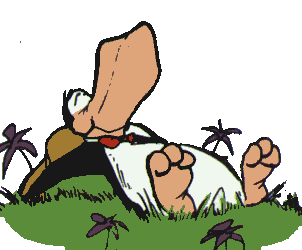
Our next character holds the unique distinction of being the star of three different newspaper comics over the years. Opus the penguin first appeared in the early 1980s and was featured in Bloom County, Outland, and Opus, all created by cartoonist Berkeley Breathed. He (Opus, that is) is a humble fellow who enjoys fish heads, long walks, philosophy, and wearing hats with fruit on them. In short, suspiciously effete. Opus’s mannerisms and thoughtful, poetic personality make him lovable, but you gotta admit, he’s hardly macho. I do feel like he’s become a bit more heterosexual in recent years, but back in his Bloom County days, well....he broke off an engagement to a hot chick once, and another time, he was actually suspected of being a female in disguise. And, let’s see, he’s obsessed with self-image, polite to a fault, adored by women without being desired by them, a mommy’s boy, carries an umbrella when it’s not raining, and has a crush on Diane Sawyer. See? Every single clue points to Opus being a man’s man! Well....except for the fish heads.


Scar (The Lion King)
This guy’s the reason I started this list in the first place. I dunno when I first realized that Scar was gay, but once I saw, I could not unsee. LOOK at him, for crying out loud! He’s clearly more interested in being queen than king! Everything about him is flamboyant, from his stylishly emaciated frame to his mincing walk to his flowing black ’do. In fact, I swear he’s wearing makeup. Jeremy Irons voices the fratricidal feline with a delicious drawl, and totally gets into the vampy mood; just listen to him utter the word “Sen-SAY-tional!” as Scar gives his mane a sexy toss during his big musical number. Said musical number (“Be Prepared”) is choreographed like Busby Berkeley from hell, and I’m sure Scar wouldn’t have it any other way. His resentment towards his brother and nephew take on a new twist when you imagine him as the ostracized queer of the family. Not that I’m advocating sympathy for Scar; he’s evil through and through. But he can take his place alongside the great bitches of cinema. Move over, Tim Curry; you’ve been out-vamped by a guyliner-sporting quadruped. It was my revelation about Scar’s fabulousness that led me to start spotting other cartoon gays, and so I owe him one.


Timon (The Lion King)
Good lord, another character from The Lion King?! Well, you gotta admit, the movie’s a bit of a sausage-fest. So while all the lionesses are busy being unimportant, Simba is chilling in a three-way bromance with Pumbaa the warthog and Timon the meerkat, the latter of whom sends my gaydar a-bleeping. It’s not just that he’s voiced by the gloriously gay Nathan Lane. It’s not just that, like Bugs Bunny, he performs best in drag. It’s that he is so obviously crushing on the handsome hunk of lion who becomes his surrogate kid brother. Like Itchy, Timon gets way too jealous when someone else, especially someone female, enters the picture. His dismay and resentment when Simba and Nala went romping romantically through the dewdrops was rich enough to spread on toast. Poor Timon; after years of just the well-meaning but malodorous Pumbaa for company, he gets someone as dreamy as Simba, only to lose him. Yeah, it’s more comic than tragic, but still. Come to think of it, there’s a lot of adult subtext to The Lion King, isn’t there. All these themes of alienation and not knowing your place in the world. I mean, meerkats are among the most social of creatures, and yet Timon has absolutely no interaction with his own species. What would drive a charismatic young male to leave his home and family, totally severing contact and.....................oh.


Wally (Dilbert)
I’m a tad dubious about this last one, but since Scott Adams’ comic strip skewers pretty much every aspect of humanity, why not gays as well? Wally is the coworker of Dilbert (“friend” is too strong a word in the übercynical universe of this comic), and something about him makes me wonder. He’s been married, is now single, and seems to view sexuality with dry, apathetic amusement. Sometimes he drops hints that he’s bicurious, and it’s impossible to tell if he’s just fucking with Dilbert’s head or not. Overall, Wally acts like he’s in on some big joke that everyone else isn’t, and is having fun at their expense. If he seems too small, ugly, and bland to be gay, keep in mind that Dilbert is all about being crushed by a faceless corporate behemoth and fighting back in small yet satisfying ways. If Wally’s gay, he didn’t realize it until he was already trapped in cubicle hell, so now he’s treating his closeted sexuality like a big prank played on the world. It’s what keeps him sane. I suspect he has an absolutely nutso fantasy life at home (which could partially explain his divorce), and is just waiting to retire and turn into a shorter, more potbellied Ian McKellen. Only then will the true Wally emerge...and when he does, we’d better cover our asses....literally. Oh, snap!

Friday, June 4, 2010

Whimsical Games You Can Play During Your Lunch Break

The dictionary defines “Whimsy” as “anything odd or fanciful; a product of playful or capricious fancy.” This objective definition sort of hints at the general reaction of people to whimsical things. Kids love whimsy; adults, on the other hand, may either love it or want to bash it to death with a shovel and bury it forever beneath a rendering plant. Me, I find whimsy to be quite amusing and enjoyable, to a point. When it comes to video games, a dose of whimsy can make a good game even better (see: Psychonauts), but a full-length game drenched in whimsy might be a little much to take. Fortunately, the digital realm has room for small, indie programmers who make small, indie games in which whimsy is the whole point of the venture. Here are a couple such games, both of which I enjoyed a lot. If you’re looking to beat your boredom for an hour or so and the endless expanse of the internet just isn’t doing it today, you could do worse.

Samorost is the first game by Jakub Dvorsky, the main mind behind the Czech game company, Amanita Design. If you haven’t heard of these folks, shame on you; they just made their first mainstream release, Machinarium, an awesome point-and-click adventure that everyone should play and be charmed by. I may review it later. But before there was a city of robots, there was a small gnome in a white jumpsuit, kind of a spiritual brother to Saint-Exupéry’s little prince, drifting through the endless cosmos on an asteroid that looks like he made it out of stuff he found on the Jersey Shore. In the original Samorost game, the gnome notices that another asteroid -- this one resembling an aerodynamic chunk of driftwood -- is about to crash into his. So he flies over to the offending satellite, and the game consists of you exploring six different screens, solving puzzles to advance and ultimately divert the driftwood’s course. Yes, only six screens; the game is really, really short and goes by in a flash, but it leaves quite the impression. I absolutely love the graphics; they consist of little animated figures superimposed over surreal pre-rendered backdrops that are literally a photo collage come to life. It’s like Dvorsky cut pictures from magazines and scanned them; maybe that’s exactly what he did. The result is vivid, charming....and oh so whimsical. This teeny-weeny little game stays in your mind, not because of its puzzles (which are fun but simple, mainly involving you clicking on stuff in the proper order), but because of its cool and unique visual flair.

There’s a sequel, Samorost 2, in which the gnome’s dog is kidnapped by some sleazy aliens and he flies to the rescue. It’s a bit longer (just a bit), and continues the trend of quirky pre-rendered landscapes. The puzzles are also a little more complex, and require you to look closely at what’s on the screen; they have a fun Rube Goldberg quality that would later be put to awesome use in Machinarium. I feel like the sequel is paced kind of weird; it doesn’t end when you think it will, and although a longer game is never a bad thing, this one seems either too long or not long enough, I dunno. I’d love it if Amanita would make a Samorost 3, maybe one that takes advantage of their new mainstream cred and is actually a full-length game with more than two worlds to explore. Hell, if they win enough acclaim, they could turn this whimsical idea into the next Myst! Or maybe not. But Samorost and its sequel are totally worth checking out just for their visual charm and sense of eccentric humor. Check out Amanita’s site -- you can play the first Samorost and part of the sequel for free, though you’ve gotta dish out five bucks for the full Samorost 2. It’s worth it!

http://amanita-design.net

Windosill is a game I spotted on Steam, and as it was only $2.99, I tried it out. It’s very different than Samorost, but has the same kind of whimsical mindset. I don’t like it quite as much, mainly because it lacks any kind of story or narrative. Remember what I said about too much whimsy? Windosill almost crosses the line, but is saved because of its innocence and (again) extremely short play time. The goal of the game is to guide a small toy car through ten “windows.” The car stays on the sill at the bottom of the screen, and in order to unlock the door to the next screen, you must interact with the creatures, structures, objects, and landscapes before you. I’m being vague because it’s hard to describe what you see in this game; everything has an abstract feel, like you’re inside a child’s mind or a housepet’s idea of the world. This effect is enhanced by solid colors, simple geometric forms, and smooth surfaces on everything. The graphics aren’t as cool as in Samorost, but they have their own soothing charm. The puzzles are pretty easy, once again revolving around clicking on stuff in the right order, but they do encourage you to think and experiment. Windosill would be a good game for a child in the 6-9 age range, but these days, most six-year-olds are probably busy playing Modern Warfare, or kicking your ass in L4D2. God, I feel old.

Anyway, Windosill isn’t for everyone, especially not those who want their video games to have a purpose beyond killing time for twenty minutes or so. Also, Samorost and Windosill both have limited replay value because of their incredibly short length and relative ease. I’m still gonna play them again, though, because playing through a game like this once you know how to solve all the puzzles is almost a zen-like experience. And, dammit, these games are so bloody lovable. If you loathe the idea of a lovable video game, sorry. You’re probably a true gamer. I, on the other hand, am a shameless artfag, probably the textbook definition of the dreaded Casual Gamer. So I find these whimsical little games to be pretty awesome.

Sorry, Roger Ebert, but you and I must agree to disagree. Games can be art. The games I just reviewed, for instance. If you like seeing indie-minded creativity in action, play ’em. Despite their miniscule length, you won’t be disappointed.

Here’s the official site for Windosill; you can play the first half of the game for free, and purchase the complete game if you want:

http://windosill.com

Thursday, May 27, 2010

Lost: The End (2/2)

The End

In our past, we were broken.
In our present, we were lost.
In our future, we were healed.
In our church, we were whole.

Part Two: Leaving

--All right, time to wrap it up. Or at least, wrap up this particular chapter of a long and timeless story. Just because Lost ended doesn’t mean the story of the Island is done. It will never end; that’s the point. Every time and place is a waypoint to somewhere else. And death, well, death may be the end of the line if that’s what you want to believe. Or it could be just another transition, a way of moving.....sideways. Yes, in a final twist that will doubtlessly be debated long into the future, the sideways world, the place I’ve been calling Timeline LAX, turned out to be....a waystation. A stopping place for a select group of people who came together to do something extraordinary. They found each other in life, and they found each other again after life. Because what they did was important enough to earn them the right to go out together.

--Some people are mad, I know. With a TV show like this, the riskiest thing you can do is pull a twist that cancels out what’s come before. It Was All a Dream! It’s All Going On In Someone’s Head! Or, in this case, They’ve Been Dead the Whole Time! I’ll admit that my first reaction was, “Oh, come on!” Then I thought about it, and found that I didn’t mind so much. See, the sideways world is more complex than your usual idea of Purgatory. After all, it came into being simply because of our heroes, and within its confines, as they unwittingly waited to move on, they had a chance to give life another try, to make things different, for better or for worse. Think about it -- if you had the chance to examine your life from a different angle or scenario, wouldn’t you do it, just to see? The Lostaways did not consciously realize what was going on; they had to be clued in, activated to the truth by contact with one another. And, over the course of the finale, that’s exactly what happened. It’d be a long and pointless chore to break down the entire sequence of events, so I’m going to go character-to-character, describing their revelation and why their sideways story mattered.

DESMOND: As always, our time-unstuck Scot had a unique role to play. He’d already found happiness in life, but due to his special mind, it seemed right that he had to be the first to reawaken and take action. Sideways Desmond had the life that living Desmond used to think he wanted, but he learned that some things are more important than respect and influence. Of course, he found Penny again, because if any two people were fated to be together, it’s them, by golly. It was easy for Desmond to let go; in some ways, he was very lucky to find happiness in life before anyone else. Damn if he hasn’t earned it!

SAYID: Ahhh, one of the biggest fan complaints. Why the HELL did sideways Sayid wind up with Shannon and not Nadia? It’s a little disturbing, that whole triangle; it’s like, whenever Shannon’s around, we’re supposed to pretend Sayid’s original love doesn’t exist. But (and I know this is a controversial thing to say) maybe Nadia was never quite right for Sayid. As Kate has proved with her two men, you can love different people but still acknowledge that they’re not the one to spend your life with. Sayid’s past is dark, violent, and angry; Nadia, sweet and nurturing though she may be, is part of that past. Remember how he literally had to torture her? Sideways Sayid sadly rejected Nadia because Sayid’s personal journey involves forgiving himself. In a scene that I found really sweet, Hurley and Boone conspired to put Sayid and Shannon back together. Why? Because the Island gave everyone a chance at a fresh start, and for Sayid, that included a new love not mired in the tragedies and guilt of yesterday. He will always love Nadia. But your first love should never be your last, people. You move on. As Sayid did.

CLAIRE: What was the biggest question on Claire’s mind the whole way through? It was, Can I be a mother? Yes, Claire, you can. Despite loss and tragedy and abandonment, you can be a mother. Kate told her that when she didn’t want to leave the Island. Kate, despite all her flaws, knows how to nurture. Sideways Claire was once again pregnant and abandoned, dumped by everyone.....at first. But then came Kate, and the Shepherd family, and Charlie. People to help. People to care. Claire wound up birthing Aaron all over again, backstage at the fateful concert, and it acted as a confirmation: Yes, you did it right. This is your son; see how alive he is! You never, ever failed him! That moment was what reawakened both Claire and Kate, the secret bond that mothers see in each other’s eyes. But a father is always needed at some point, and so Charlie got to be there as well. For his own personal journey involved learning to nurture rather than destroy, and with his own death, he succeeded gloriously.

HURLEY: Well, we already saw Hurley’s reawakening with Libby. Wasn’t it adorable? Seems appropriate that Hurley was the first one to have his revelation after Desmond. Because Hurley, remember, is the caregiver. So who better? I loved Hurley’s look of joy when he kidnapped Charlie, and the way he conspired with Boone, who is apparently way, way cooler than his Island exploits made him out to be. Maybe it’s because he’s spent some time as a vampire. But in all seriousness, let’s remember that the “activated” sideways Hurley also has all the wisdom from his time as Island keeper, which could have been even longer than Jacob’s reign for all we know. He’s practically a Jesus figure! Though he’d hate to be called that, the big sweetheart.

SUN AND JIN: Pretty easy to interpret. In life, they were kept apart by many people and forces, including their own doubt. So now, they get a do-over in which their love never wavers and they overcome all obstacles. I don’t think the bad guys, Keamy and Omar and Mikhail, were “real” in the same sense that our heroes were. They weren’t the actual souls of the men, but were conjured up by the sideways world to serve as proof that devotion conquers evil. The overcoming of evil serves as a reconfirmation of good. See how happy Sun and Jin were upon their reawakening, even knowing how they’d died? What was important, what made them smile, was that they died together, in love and loyalty. And little unborn Ji Yeon appearing on the ultrasound? A gentle reminder that they made a life before they lost theirs. A triumph.

MILES: Heh, I’m not sure. Was that the “real” Miles we saw in the sideways world, or another virtual person designed to interact with Sawyer? For that matter, what about Daniel and Charlotte? Okay, I think the two of them were real; their meet-cute at the concert suggested that they’re themselves. They just aren’t ready to move on yet. Not everyone was. I feel like they’ll get their moment; we won’t see it, but it’ll happen. As for Miles, well, maybe he has to make a kind of final peace with his father, Pierre Chang. Maybe then he’ll get his turn.

ELOISE: Yeah, she was real. When she asked Desmond if he was going to take her son away, that gave her away as real. But because Eloise Widmore/Hawking is the Grande Dame of Time Travel, she was perfectly aware that she was in a virtual pseudo-afterlife. And she took full advantage of that, creating a life where she could hold onto those she’d loved: her husband, Charles Widmore, and her son, Daniel. A life where she did not have to push Daniel or dominate him....or kill him. A life where she could be happy, even knowing it was only a temporary waystation. So she’ll be staying there until she’s quite satisfied, thank you very much.

SAWYER: Interesting that sideways Sawyer seemed just as flawed as living Sawyer. A cop rather than a con man, but still haunted by the same guilt and rage. Why would he subconsciously create this for himself, rather than some ideal, drama-free sideways existence? Well, letting go is harder for some people. Sawyer not only had to let go of his baggage, he had to let go of Kate, who appeared to him as a temptation. Should he help her escape? Throw in his lot with this woman whom he desired so deeply? No. Because, though they loved each other in life, they didn’t really heal each other. Sawyer found someone else to heal him, someone whose presence in the sideways world soothed all wounds. And that someone, bless her heart, is.....

JULIET: Took you long enough, show! Yeah, so...to my annoyance, she was indeed Jack’s ex-wife. But, to my relief, they only shared one scene together and it was clear they’d stayed friends rather than stewing in awkward resentment. To Jack, Juliet was the flawed ideal, the “We could have, if only....” But to Sawyer, she was life and love itself. Of all the reawakening scenes, my favorite was between Sawyer and Juliet. I loved the vending machine business, which cheekily mirrored the Island and its Core. And then, when they remembered, when Juliet broke down and Sawyer held her, held onto her like he’d failed to do in life....holy shit. “Kiss me, James.” “You got it, blondie.” And I cried. That was the one moment where I actually cried. That’s how perfect this couple was.

BEN: Oh, how I cheered. I’ve been hoping for a full-blown Ben redemption, and boy did I get it. It was really neat and appropriate how Ben wasn’t ready to move on yet. Not just because he was reluctant to leave his cozy new sideways life with Danielle and Alex, but because he wanted to...think about some things. Well, that’s very wise of him. Passing out of life is not something you should ever do lightly, and the complexity of Ben’s life surely required some self-reflection. He was a bad man once. He killed people, lied, manipulated, stole a leadership that was never meant to be his. But was he evil in the same way that the Man in Black was evil? Of course not. No human being is all good or all evil. Ben wanted to think about his own duality, and so he’s outside, waiting. He’ll always be the outsider in many ways, but that no longer bothers him.

KATE: So, after all this, who did Kate choose? Jack or Sawyer....or neither? Well, that’s interesting, because I honestly don’t know. It’s important to note that, while many of her fellow castaways were reawakened upon contact with a lover, Kate had her moment as Aaron was born. It was not brought about by Jack or Sawyer. It think this may be linked to Kate’s much-debated absence from Jacob’s final list of candidates. He realized, and she eventually realized, that her place in life isn’t what she thought. It’s not being a lover, or a killer, or a shaker and mover. She always tagged along and got on our nerves because she wanted someone to depend on her, but that dependance took a form she didn’t see coming. “You became a mother,” Jacob said. Yes, and that’s what mattered in the end. She couldn’t be with Sawyer because they just exacerbated each other’s flaws. She couldn’t be with Jack because each wanted the other to depend upon them. What Kate needed was to stop playing the bad girl. Note that sideways Kate was innocent. Yeah, we just have her word on that, but I believe her for once. Innocence heals; guilt deepens the wounds. As she learned.

LOCKE: In life, he failed. He strove to do something and be something that was so, so important, and he failed, and became a pawn of an evil being. He lost his life, his dignity, and even his face. But sideways Locke? He got another chance to learn what matters, what happiness is and how to find it in the face of adversity and tragedy. At first, he took the self-indulgent route and accepted the wheelchair, even welcomed it. Punishing himself. But sometimes, you need to accept that you make mistakes and can’t do everything. Basically, Locke told himself what he couldn’t do. No one can tell you what you can’t do; you have to decide for yourself. Try to do everything, and you’ll get nowhere. Try to be a martyr and you may wind up on a pedestal, but it’s cold and lonely up there and you’re too high to hear people’s voices. Locke finally listened, both to himself and to others, and wound up winning back the use of his legs. He learned the humility to allow someone else to fix you, and as a result, he got to leave this life with grace and poise, on good terms with his former antagonists. He went out with a bang, not a whimper.

JACK: Yes, Jack. The hero, the fixer, the man who had the most trouble letting go. But let go he did. In the sideways world, he had a son, and although David was not real in the sense that you and I are real, he was real in the ways that mattered. He allowed Jack to avoid the mistakes he’d already made in life, the daddy issues, the resentment and misplaced sense of responsibility. Jack had to let someone else go before he could let himself go, and that someone was the son he’d never had. Letting David go, fixing Locke, coming to terms with his father’s death -- these were the steps Jack needed to take before he could be reminded of how he’d died, the great and noble sacrifice he had made. The finale really made Jack into a Christ figure, complete with bleeding stigmata, but don’t panic; it’s a metaphor. Jesus Christ was literally made to help others, and could never help himself. God wasn’t interested in Christ’s own welfare, because God (or Fate, or the Island’s Source, or whatever you call it) has to be cruel a lot of the time. It was cruel that Jack was always meant to die, but cruelty and comfort go hand in hand. Another duality. Balancing the two halves of a whole leads to grace.

THE MISSING:
Some people didn’t make it. Some people weren’t there in that church, and didn’t even appear in the sideways world. Let’s briefly discuss why...
EKO: Okay, yeah, the real reason is because they couldn’t get AAA to come back as Eko. Which makes me sad. But Eko was always a loner, defiantly resistant to redemption. The Monster killed him for this very reason. Eko never wanted to forgive and let go, so why should he be here? He walked his own lonely path by choice.
MICHAEL AND WALT: Michael failed. Yeah, his last living act was redemptive, but it wasn’t enough. His story is one of the most tragic on Lost, because although he was a good person, he did one thing so bad that it broke his chances. He was trapped. He became a Whisper, unable to move on. Poor, poor Michael. As for Walt....well, I do wish we’d seen him in the church at the end. I think leaving Walt out was a mistake on the show’s part. Oh, well.
ANA-LUCIA: Not ready yet. Desmond said as much. She was a deeply flawed and troubled woman, and it’s gonna take her awhile to work through the shell she built around herself. Doesn’t mean she won’t do it eventually, though.
FRANK AND ILANA: I’m putting them together because I feel both of them would be equally resistant to all this romantic, symbolic nonsense. Frank and Ilana were practical functionaries who happily did what they’d signed up to do because they knew it was what they were meant for. They had it much simpler than all our Lostaways with their endless baggage. In a way, both of these folks made the necessary peace with themselves ages ago, because there was so little to forgive! Ilana did appear in the sideways world, and....do you think that Ilana the lawyer knew the truth and was quietly helping Jack and Claire find their way? I think she just might have.
RICHARD: A man who had a long, long, long life. A life in which he was never truly happy or content. I can’t imagine he would have wanted to linger in some dreamy afterlife, even if it meant generating a sideways copy of his love to snuggle with. He was ready to move on a long time ago.

--So, that about sums it up. In a beautiful church of no single religion, all the friends and lovers came together for one last hurrah. Jack was the last to arrive, and he found his father waiting for him. His real father, not a sham. Christian Shepherd was there to play, well, the shepherd, opening the doorway for our beloved gang. Why a church? Because, all religions aside, a church is universally a place of quiet comfort, serenity, and community. A place where you can spend time with those you care about, without all the hassle and stress of the outside world. A place where no one will complain if you just sit and rest and think awhile, no matter what your faith. I mean, I personally follow no religion, and yet I have never felt awkward or unwelcome in a church. This was their place, the final space they chose to make. And it was where they sat together while the way to....whatever came next....was opened for them. At the same time, we saw Jack die peacefully, good old Vincent keeping him company, his final seconds perfectly mirroring the opening seconds of the entire show. A cycle. A transition.

--And that’s the end. Some people were a little confused and thought that we were supposed to infer that everyone had died in the initial plane crash. This wasn’t helped by the shots of the Oceanic 815 wreckage that ABC chose to insert over the end credits; people thought those images were meant to be important somehow. (They weren’t.) No worries, folks, Lost wouldn’t be so lame as to go with the “They’ve Been Dead the Whole Time” ending. Yeah, in the sideways world, they’ve been dead the whole time. But they all arrived at different times, some earlier, some later. The sideways world has nothing to do with real space and time; it was there for everyone exactly when they needed it. Because, hell, these people saved the world. Each of them helped in their own way, so they’ve earned this. And so have we. And while I would have loved to see a snapshot of the surviving characters’ post-Island lives....well, that’d just be copying Six Feet Under, and it probably wouldn’t be as good as I can imagine it in my mind.

--Lost is over. I fell in love with the show after hearing the very first promo for it. I thought it was going to be cool and unique, and I was right. It exceeded so many expectations. Parts of it sucked, I will admit. There are mysteries left unsolved (the food drop in Season Two...where the fuck did that come from??!!), characters I wish they’d handled better (why hire Lance Reddick if you’re not gonna do anything interesting with him?), backstories that were insufferable time-filler (Michael’s custody woes, Charlie’s puke-a-thon, and Jack’s whacky Thailand adventure can all go fuck right off), and a lot of other frustrations. But there were also brilliant and complex characters, gorgeous visuals, top-notch acting, mind-melting revelations, fun comic relief, deep tragedy, and a plot that delighted me with each new, intricate little cog and spring and hidden chamber. Lost took us backward, forward, sideways, and beyond in a roller coaster of fascination and enjoyment, and I will always treasure it. As I will treasure my DVD collections of each season. I never want to stop watching, because I know that each new viewing will bring new surprises and insights. The show will just keep on giving. And, hopefully, it will go down in history as a work of collective genius.

--Thanks for reading. What a long, strange trip it’s been. I’m signing off now. And, though it’s hard to do that final sound effect as an onomatopoeia, here you go:


BOOM.

Wednesday, May 26, 2010

Lost: The End (1/2)

The End

First, there was mystery.
Second, there was fear.
Third, there was anger.
Fourth, there was regret.
Fifth, there was confusion.
Finally, there was truth.

Part One: Island

--It’s taken me awhile to begin writing my recap/review/reflection on the finale of Lost. I’ve had to do some thinking. Normally, I try to write an episode recap/review right away, while it’s still fresh in my mind and I haven’t been influenced by what anyone else thinks. (Case in point: I might’ve been a lot more critical of “Across the Sea” if I’d waited to see the backlash.) But this is The End, folks. I can’t just bolt it down like a Happy Meal; I need to digest it like a gourmet dinner. And many of the things I’ve read that other people have said or pointed out...they helped me form my own conclusions. And because it was so huge and required such thought, I’ll be doing this in two parts. Part One examines the climactic events on the Island, while Part Two will be all about the sideways world, what it is, and what it meant for each character to be there.

--So, yes, I loved the finale. Was it perfect? No, of course not. How could it be? How could six seasons be neatly wrapped up in one two-hour block? Plenty of questions were left unanswered and new ones were raised. But, as others have pointed out, Lost is about its characters, its people. That was what they wanted to address in the finale -- the characters we know and love. How much time would be left for character closure if they’d used it all up meticulously explaining every tiny, pissant mystery? The final clash between our heroes and UnLocke was thrilling and intense, and intensely personal. As it should be.

--The images of the Island....so beautiful! UnLocke standing on the edge of a rain-swept cliff like the last man on earth. Kate peering through a tapestry of brilliant green fronds like Eve herself. Frank rising from the waters like Jonah (oh, how I cheered!). Two faces gazing down into a golden chamber in a shot that deliberately echoed the famous Hatch zoom that ended Season One. A bamboo grove, peaceful and isolated. A plane. A dog. An eye. And then.....

--Getting way ahead of myself here. The gorgeous cinematography echoed the theme of the show, the duality and life and death, creation and entropy. UnLocke was the agent of destruction and chaos, determined to destroy the Island and tip the world off its precious balance. Jack was the hero and the shepherd, making the ultimate sacrifice. And Desmond was the tool, the weapon, his special connection to the Island’s energy rendering him immune to the deadly effects of the Core. Both sides needed him, but both Jack and UnLocke realized that there was literally nothing they could do but lower Desmond to his destiny....and see what happened. What a beautiful, wicked moment -- the two men, so completely transformed, enemies, yet equally enticed by the promise of that golden light, that Core. And Desmond, serene because he was convinced that once he did his deed, he could escape for good, one way or the other. But it didn’t work that way. Once Desmond pulled forth the stone plug, what came out was not golden and healing but crimson and malevolent. The Island began to shake itself to pieces, and UnLocke discovered he’d become mortal. Why? Perhaps because, as the Monster, he had always been connected by an invisible lifeline to the power of the Island, and when the cork was pulled, that link was severed. He was part of the Island itself. His victory was his downfall.

--Ah, but it wasn’t just Jack and UnLocke, was it. Sawyer, Kate, Hurley, and Ben had to be there as witnesses. Why them? Well, who else? So much of the show has revolved around Kate and Sawyer’s love and stubborn determination, Ben’s search for meaning, and Hurley’s deep, seemingly endless compassion. All were central and all were addressed. I loved it when Kate joked about tagging along with Sawyer; that moment alone made me forgive a lot of her past idiocies. I did find it weird that no one confronted Ben about seemingly siding with UnLocke, or even mentioned it. I suppose that when the shit hit the fan, everyone was appropriately shocked and awed to throw their differences aside -- and like I said earlier, Ben was just following UnLocke to keep himself alive, not because he harbors any remaining animosity towards the castaways. Ben is a follower, not a leader, and so his role helped foreshadow what was to come. And thank you so much, show, for bringing back Rose and Bernard! Yes, they too flashed back to the present and are still living quietly on the Island. When they rescued Desmond, they inadvertently brought UnLocke to their door, and yeah, for one horrifying moment, I thought the writers might be that mean. But, no, Rose and Bernard are safe. Their love for each other is just as vital to Lost as any other love. They are the keepers of truth.

--Miles, Frank, Richard -- wonderful. Yeah, they mostly played a functional role in the ep, getting Flight 316 ready to fly. But were they unimportant? Never. They represented the common man, the humble everyperson who does the right thing, helps when help is needed, but is practical enough to keep his or her own skin intact. They each had their moments. Richard found a gray hair, a sign that the tired old ways are changing -- and, judging by his reaction, he’s more than ready. Miles proved that under his cynicism and hilarious assholery, he’s a decent human being. (He also got away scot free with those diamonds, and I couldn’t be happier.) And Frank, well, he did what he’s always done. He flew the plane. “Here we go,” the pilot whispered as he coaxed the battered, scarred hulk of 316 down the runway that the Others had built without even knowing why it was so important. It was important because good, everyday people like Frank and Richard and Miles are what keeps the world together, but even they need help from others. Everyone helps everyone.

--So....a final, brutal battle on that haunted clifftop. A fatal wound for Jack, a stigmata. But who killed UnLocke in the end? Kate. Kate, the rejected candidate, the criminal, the mother. A provider of life, here to take it away. With the Younger Brother’s long, sad, broken excuse for a life brought to its end, Jack went to do what he realized he was supposed to do all along: die. But die so that others might live. Jack dropped back into that beautiful, deadly Core and, like Frank, did what he does, what he’s always striven to do. He fixed. And who was left to take on Jacob’s duties? Oh, God....I laughed and I cried. Hurley. Poor, kind, reluctant Hurley was the right one all along. I used to hate the idea that Hurley might be the new Jacob, but in the context of the finale.....who else, really? Jack is the fixer. Kate is the mother, with the mix of life and death that entails. Sawyer is the father, the strong provider. And Hurley, what does he do? He takes care of people. That was what Jack realized: that though you may spend your life attempting fix people and sometimes even succeed, it does them no good unless they are cared for. Now things will be different. Jacob kept the Island together, but it was never meant to be his job, and he knew it. His rule, his role, was flawed. But maybe, just maybe, things will be better with Hurley in charge. Not just on the Island, but among all humanity. And Ben, who has realized the truth about himself and a lot of other things, gets to be Hurley’s loyal and experienced right-hand man. The way it was meant to be. Everything falls into place. Everyone finds their proper role to play, and all is well. Or as well as can be when we’re talking about the ever-changing mix of love and loss that is part of every human being.

--I’m not going to talk too much about the final moments on the Island, because I feel it makes more sense to discuss them in relation to the final moments in the sideways world. That comes in Part Two. But I will say that another huge Lost theme is the Cycle, and those final, quiet, tragic, triumphant moments in the bamboo grove brought everything to its proper...beginning. And no one has to die alone. And death need not be mournful, especially when the sun is shining and a gentle breeze is blowing. And when they assured us that Vincent would still be alive at the end, we had no idea of the significance of that statement. Because, hey, Vincent also did exactly what he does. And what does he do? Oh, come on. Do I really need to answer that?

--So, the Island still stands. Some stayed, some left. I am sad that we’ll never know what happened to our heroes next. What did the passengers on the final flight of Ajira 316 do once they returned to the real world? Did Sawyer and Kate make a life together? Did Miles become a millionaire? Did Richard find the life and death he’d been denied for so long? Did Claire finally become a mother? (I didn’t mention Claire earlier because her final scenes on the Island speak for themselves, but I’ll touch on them in Part Two.) And what about those who stayed behind? Did Desmond make it back to Penny and little Charlie? Was Hurley a good leader? Did he round up the scattered remnants of the Others and the original 815 castaways (assuming any of those poor redshirts survived at all) and build a better society? And, when all is said and done, what about Walt? We’ll never know. Though this pisses me off a little (the sneaky bastards promised Walt would appear, and he did....in archival footage. Fuck you, Darlton), I’m happy to see that I still have the grace to accept what I cannot control. And besides, now we can all imagine the lives our heroes had, and imagine them in the way we prefer.

--Except for Jack. Because Jack died. Just like he was always meant to. And his death, and the idea of turning back the clock and remaking your life how you want, or think you want, ties directly into the revelations about the sideways world and the other big conclusion to Lost. So stay tuned for Part Two...and my final thoughts on the finale.

--(Not necessarily my final thoughts on Lost, though.)

Thursday, May 20, 2010

Lost, Season 6, Episode 16

6.16: What They Died For

--Not sure how much I like this episode. Maybe I should be more forgiving...I mean, I recognize its quality and it had some downright awesome moments. I think I’m starting to get freaked out about the series finale, to the point where I’m being overly harsh. Also, “set-up” episodes bug me. This is, of course, the last set-up episode that Lost will ever have, but still. The stage is set for the big finish; the characters know more or less where they’re going and what their goals are, and so do we. Oh, there will be last-minute twists and turns, or so one assumes. But the end is on the horizon. To our chagrin.

--Things were moving right along in Timeline LAX, where Desmond, I swear, has become Professor X. Seriously, he’s doing the whole “I’m here to unlock your potential and recruit you for an amazing task, and by the way, I already know everything about you” thing so well! All he needs is to steal Locke’s wheelchair and shave his head. But for now, he meddled in the affairs of a bunch of people -- he prank-called Jack about Christian’s missing body, he beat up on Ben, and he sprung Kate and Sayid from the slammer with the help of Hurley and (hilariously) an oblivious Ana-Lucia. It all seems to be coming down to the big concert where Jack’s vampire son will play. What will happen that night??!!! Is there any remaining hope that Jack’s ex-wife won’t be Juliet???!!! Is Lost going to rip off that opera house business from Battlestar Galactica???!! Oh, and Locke’s starting to think that he was wrong and Jack was right. Will Locke walk again???!!! And what other familiar faces might we see at the concert???!!! Yes, I’m excited.

--So, yeah, it’s Jack. Jack is Jacob’s replacement, barring some last-minute switcheroo, which seems impossible given that Jacob seems to have flown the coop for good. After summoning Jack, Kate, Hurley, and Sawyer for a poignant fireside chat, Jacob did the whole mystic communion deal with the former man of science, and I guess that’s that. Lame. Good scene, though. I liked seeing Sawyer’s intense guilt and Hurley’s smart detachment (“I’m glad it’s not me” -- and so are we, Hurley!). Also, interesting that Jacob crossed off Kate’s name because she became a mother. Mommy issues much? Kate was less annoying than usual and Mark “Jacob” Pellegrino has never been hotter, but I felt like Jack rose to the occasion too easily. Also, the dialogue never really answered the question of whether or not Sun, Jin, Sayid, and all the other dead ones had to die. Did Jacob know they would? How much was him and how much was his evil brother? Meh, I guess I’ll have to be satisfied.

--Whoa, Ben’s gone all Snape on us! That is, he has us wondering if we should be howling for his balls on a platter or congratulating him on successfully hoodwinking the Island’s very own Voldemort. He, Richard, and Miles met with Widmore and Tina Fey in the barracks and might have hammered out a deal, but then UnLocke appeared, and...
--MILES ran like the hilarious coward that he is. I so hope he survives, because he’s worked so damn hard at saving his ass. Spare the comic relief!
--RICHARD tried to stand his ground and got body-checked by black smoke. Is he dead? The show had better give us some closure on him. While we’re on the subject, Frank didn’t even get mentioned, so either he’s still alive (maybe Claire will rescue him?) or they’ve utterly failed to do the character justice.
--TINA FEY was murdered by UnLocke. Brutal, yes, but did you really expect a recurring character to be allowed to live at this point? Bye, Tina Fey! Loved you on SNL with Betty White!
--WIDMORE revealed his Desmond gambit after UnLocke threatened to kill Penny. It’s kind of appropriate that Widmore so utterly failed, because his character is all about failure: he can be rich and powerful, but he can never obtain the things he truly wants. Because he is weak. And now dead.
--And finally, BEN put his lot in with UnLocke, betrayed his companions, and agreed to kill our heroes. Or did he? I just can’t believe that Ben’s sunk back into darkness, not after his redemption earlier. I think that Ben’s pulling the wool over UnLocke’s eyes and will reveal his true noble intentions at the crucial moment, probably dying in the process. Yes, he shot Widmore, but that moment was the culmination of the hatred between the two men, and was fully earned on Ben’s part. “He doesn’t get to save his daughter,” Ben snarled, and who can forget Alex’s pitiful death at the hands of Widmore’s man? No, Ben’s not a lost cause. Because sideways Ben is getting all cozy with the foxy Danielle Rousseau! Predictable, yes, but nicely ironic and also fully earned. So don’t write Ben off just yet, folks....

--Where does all this leave us? With the newly immortalized (?) Jack and his friends heading toward the golden light at the heart of the Island. With UnLocke plotting to destroy the Island entirely. With Desmond, the lynchpin that both sides need, out of the well and missing, rescued by.....whom? With some characters unaccounted for, others out of the running, and a select few ready to wage the final battle that will decide the fate of Craphole Island, not to mention this flawed but precious blue ball we call home. Not much to say, then, except.....here we are, and here we go.

Thursday, May 13, 2010

Top 10 Least Favorite Video Game Bosses

So, I love boss battles, but that doesn’t mean each and every one is automatically good. In fact, there are plenty of boss battles that just plain suck on balls. It kinda bites, getting to the end of a level/stage/chapter only to discover that the boss sucks, and it’s even worse when it’s the final boss of the entire damn game. Here are my criteria for a shitty boss: it requires no strategy, only endless button mashing; it’s repetitive and predictable; it’s a big old anticlimax; it’s designed to fuck you over by being different from the rest of the game; it’s lame and/or sloppy in design; it’s too damn easy; or it’s so damn hard that the flow of gameplay is broken. A boss need not meet all of these to be hated by me, but it helps. Okay, I admit that I hate some bosses as a result of personal bias. So if you find yourself going, “No way! [Name of boss] is freaking awesome!”, relax. This is my list, not yours. Here are....

DANG-BLASTED’S TOP TEN LEAST FAVORITE VIDEO GAME BOSSES

(Note: I don’t think I could rank these in order of hatred, so they’re just in alphabetical order.)


Bowser (Super Mario 64, N64)
Yeah, yeah. You know it’s true, people. Don’t get me wrong, Mario 64 was awesome, but the boss battles sucked. Especially the three fights with Bowser, which were just the same fight repeated thrice with one or two new attacks on his part. There’s no strategy at all: you just get behind him, grab his tail, and fling him into an exploding mine. And this was a very frustrating and difficult thing to do, requiring perfect timing, so you constantly failed and had to try again. And again and again. I’ve noticed that Mario bosses tend to be lacking, but Jesus. I guess the at-the-time-groundbreaking 3D conception precluded the possibility of boss fights that didn’t suck. After this ordeal, Peach had better have given Mario some bow-chicka-bow-wow. Mmmhmm.


Death/Doom/Demon/Etc. Walls (Final Fantasy, various consoles)
They have a different name and appearance in every game, but these things are one recurring feature of the Final Fantasy franchise that I wish they’d demolish with sledgehammers. I don’t work well under intense pressure, so I fail to get enjoyment out of a boss that kills me if I don’t defeat it quickly enough. The Walls crush you into oatmeal if you’re too slow, and my resultant frantic spamming of the attack command removes all strategy from a game that’s supposed to be all about strategic fighting. I mean, the concept is cool and the battles worked, but I just hated them. And no, I didn’t like the FFX version, either. Because I don’t enjoy having Pharaoh’s Curse cast on me every time I fucking sneeze.


Every Boss in Super Mario Land 2 (Gameboy)
Remember what I said about lame Mario bosses? This Gameboy sequel was actually quite enjoyable, but all the bosses were dumb and childishly easy. You just bounce upon each one three times, and it dies. And they barely have any attacks. I mean, all the rat did was scurry about, all the crow did was fly back and forth, and the three little pigs? Whooooaaaa, each one jumps around in a slightly different manner! How unexpected and dynamic! And don’t get me started on Wario. Just don’t. If he chooses such lazy and uninspired critters to guard the six gold coins, he deserves to have his fat ass kicked.


Gary Oak (Pokémon Red/Blue, Gameboy)
I was never really seriously into Pokémon, but I did play the original on the Gameboy. Never beat it, though. And Gary Oak is the reason. Everyone hates Gary; you’re supposed to. He’s your nemesis! From the beginning, when he sneakily waits for you to pick your starter Pokémon so he can gain the advantage, it’s all downhill. I COULD NOT win the final fight with him. His stupid fucking Alakazam mopped the floor with me every time. And don’t bombard me with strategies for beating him; I sold the game ages ago. Even if I’d won and made it to Indigo Plateau and Mewtwo, I’d still loathe Gary Fucking Oak forever. I’d like to stick his smirking face in a Pokéball full of AIDS blood.


Kusabi (Fatal Frame 2, PS2)
Sigh....another game I didn’t finish because of a shitty boss. After you explore a haunted village and combat malevolent phantoms with a camera -- which rocked, don’t get me wrong -- they pull a major dick move with a final boss that pulls all kinds of shit you’re not prepared for. His main attack one-hits you, and you can’t even damage him except for this one small window of opportunity....which occurs the instant before his main attack. Get the picture? What really sucked, though, was that between the final save point and the final boss was a corridor that was about fifty fucking miles long and crammed with hard-to-avoid ghosts. After the Kusabi killed me in less than a minute, I thought: I’m expected to go through that slog again? Fuck that. Guess I won’t be watching no Fatal Frame 2 end credits. The people responsible for that dick boss don’t deserve to have their names read by me anyway.

(Note: The screenshot above is actually from Fatal Frame 3, since I couldn't find a good pic of the FF2 Kusabi. But as the FF3 version looked about the same and sucked just as hard, I think it's okay.)


Mr. Patch (Banjo-Tooie, N64)
Banjo-Tooie added the boss battles that Banjo-Kazooie lacked, and they were....decent. Except for Mr. Patch. This boss was a giant inflatable dinosaur thing (you just know some furry somewhere has fapped to him) who spat exploding beach balls. You had to fly around him, firing grenades at the colorful patches on his body, gradually deflating him. Yeah, it sounds fun, but it was just plain tedious and frustrating. The flying in Banjo-Kazooie was never very fine-tuned or precise, and the arial aiming could have used a polish as well. The result: hair is torn out, teeth are gnashed, controller is flung. Boss battles are allowed to be really hard, but not when the difficulty is the result of shoddy gameplay mechanics. Mr. Patch wins bonus shit points for failed potential.


Prince Froggy (Yoshi’s Island, SNES)
Here’s another one that sounded better on paper. While most of the Yoshi’s Island bosses were ordinary baddies that had been magically blown up to size by Kamek Koopa, this battle had Yoshi getting shrunk and eaten by a frog. You’re trapped in his gullet, battling his uvula. Seriously. Meanwhile, drops of stomach acid rain from the ceiling and big shy guys crowd in with you. Setting aside the logistical issues (if Kamek can shrink Yoshi, why didn’t he do it earlier?), the cramped setting and raining acid made it practically impossible to beat the boss without taking damage. Seriously, can someone give me pointers? How am I supposed to unlock the hidden bonus levels if this shitty, unfair, overly difficult boss battle drains my timer?


Psychonauts End Boss (PS2 & Xbox)
I won’t identify the boss because that would spoil the plot, but it provided a hideously anticlimactic ending to an otherwise excellent game. Everyone’s heard about the difficulty curve of Psychonauts, how it starts out really easy and then gets insanely difficult. Well, the final boss could be toppled by a toddler. Why? Because they abruptly hand you this super special awesome power that renders you invincible, that’s why. Here is how the fight goes: you avoid the boss for a bit, which is really easy as you are faster than it. Then your power meter maxes out and you pummel the boss invincibly for a bit. Lather, rinse, repeat. What lame bullshit is this? Oh, and in addition, the final battle has so much needless particle rendering going on that it usually causes my PS2 to crash. Dammit, Psychonauts, you are so good! How can you also be so lazy?


Walter Sullivan (Silent Hill 4: The Room, PS2)
I love the character and backstory, hate the final battle with him. Walter Sullivan is this freaky undead serial killer who must be in tight with the supernatural powers that be, because the boss fight pulls every dick move in the book. You can’t even damage him for most of it; he runs around impudently, carving away at your health with a fucking PISTOL and a fucking CHAINSAW as you attempt to retrieve some spears and stick them into this monster-fetus thing growing out of the wall. Only then can you actually hurt Walter, and the camera is totally on his side because you can barely see what you’re doing. Also, your female sidekick is marching cheerfully toward a razor-sharp death machine, and if you don’t beat Walter quickly enough, she dies and you get a bad ending. Silent Hill 4 was just a dick game in general, so I shouldn’t be surprised that the final boss was designed to ruin your happiness.


Yu Yevon (Final Fantasy X, PS2)
I put the fight with Sin as one of my favorite boss fights. Too bad the awesomeness couldn’t carry over to the actual final battle. Yeah, let’s stick this one with the other classic Final Fantasy end bosses. Zeromus, Kefka, Sephiroth, and.....a little bug-like thing that can’t kill you. Wait, what? The game goes on and on about how powerful and evil Yu Yevon is, and yet he just looks like a slightly oversized tick. And if he kills you, that cute little angel flies down and brings you back, thanks to automatic auto-life. I know that video games have gotten easier as they’ve grown into the mainstream, but why must we assume that all PS2 owners are fragile children who’ll have a breakdown if they can’t win the game? I like to pretend that the battle with Jecht is the real final battle and that all that follows is just a big interactive cutscene. It eases the disappointment of an end boss that you could squish beneath your Chuck Taylors.